




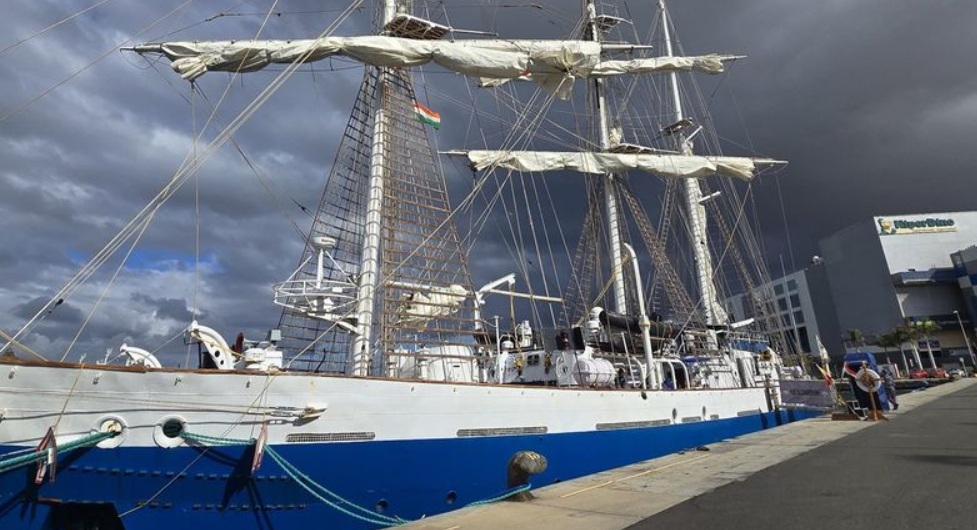
The Port of Las Palmas has witnessed a historical milestone in the international relations of the archipelago: the arrival of the INS Sudarshini. The Indian Navy’s sailing training ship has docked in the Gran Canaria docks in what represents the first official visit of an official vessel from New Delhi to the Canary Islands. This stop, part of the Lokayan 26 transoceanic expedition, transcends the ceremonial to position Las Palmas as a crucial replenishment and strategic pause node before the Indian Navy faces the jump across the Atlantic to the United States.
The deployment, which departed from Kochi in January 2026, has touched key ports in Oman, Egypt, Malta, and Morocco, spreading the message of Vasudhaiva Kutumbakam (‘the world is one family’). However, the stop in Gran Canaria has a distinct operational significance. The commander of the INS Sudarshini will hold high-level meetings with Spanish naval authorities to strengthen maritime collaboration between the two nations, at a time when the security of trade routes and interoperability among friendly navies has become critical due to the instability of traditional corridors.
The Transatlantic Leap and the Diaspora
The visit not only seeks technical exchange among maritime professionals. The ship has opened its decks to the local community and to the large Indian diaspora residing in the archipelago, reinforcing the cultural ties of a colony historically linked to the port trade of the islands. This soft power maneuver prepares the ground for the next phase of the deployment: the participation of the INS Sudarshini in Sail 250 events in the United States, commemorating the 250th anniversary of its independence.
The choice of Las Palmas over other ports on the African or European coast reaffirms the capability of the Port of La Luz to manage highly complex diplomatic stops. After its recent stop in Casablanca, where interaction with the Royal Naval School of Morocco was constant, the INS Sudarshini uses the Canaries as the ultimate logistical springboard. The Gran Canaria port demonstrates, once again, that its value does not lie solely in bunkering or container operations, but in its inescapable position as a floating consulate in the middle of the Atlantic.







