
Saturday, 17 October 2026
  • Login
  • Español
  • English
Suscribirme
Subscribe
canarymaritime.com
No Result
View All Result
  • Home
  • Atlantic Ports
    • Atlantic Africa
  • Blue Energy
  • Logistic
  • Shipbuilding Industry
    • Shipyards and Ship Repair
    • Offshore and platforms
    • Industrial innovation and naval R&D
  • Blue Economy
    • Investment and European Funds
    • Financial Sustainability
    • Private Venture Capital
  • Atlantic Geopolitics
    • West Africa
    • Port Security and Defense
    • Blue Diplomacy
    • Canary Islands as a strategic hub
    • Drug Trafficking
  • Home
  • Atlantic Ports
    • Atlantic Africa
  • Blue Energy
  • Logistic
  • Shipbuilding Industry
    • Shipyards and Ship Repair
    • Offshore and platforms
    • Industrial innovation and naval R&D
  • Blue Economy
    • Investment and European Funds
    • Financial Sustainability
    • Private Venture Capital
  • Atlantic Geopolitics
    • West Africa
    • Port Security and Defense
    • Blue Diplomacy
    • Canary Islands as a strategic hub
    • Drug Trafficking
  • Español
No Result
View All Result
canarymaritime.com
es Español en English
No Result
View All Result
Home Blue Economy & Finance Financial Sustainability

The CNMC questions the viability of the stevedoring right-wing in the face of resistance from State Ports

Raquel Molina Betancor by Raquel Molina Betancor
16 June 2026
in Financial Sustainability
Reading Time: 3 mins read
0
49
SHARES
305
VIEWS
Compartir en WhatsappCompartir en LinkedIn
Google CONVIERTE CANARYMARITIME EN FUENTE DE NOTICIAS EN GOOGLE

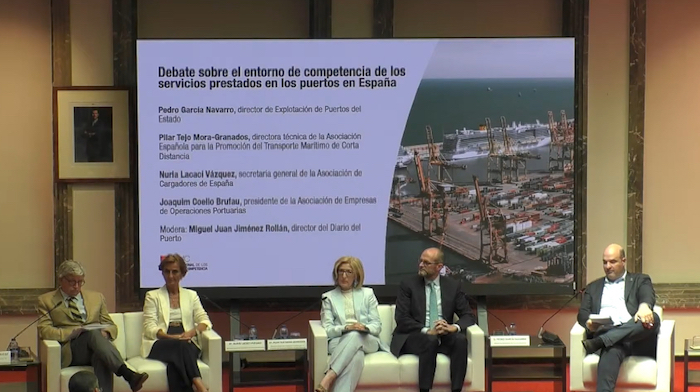
To live or not to live off the inherited rights of Franco. A country capable of joining the euro is unable to eliminate the Francoist legacy in the management of labor in ports. And this is despite the existence of a Ministry of Democratic Memory. The National Commission on Markets and Competition (CNMC) has marked a turning point in Spanish port policy. During the sectoral day held this June, the outgoing president of the agency, Cani Fernández, articulated a significant institutional critique regarding the port management system. Fernández pointed out that the inefficiencies of the sector transcend the strictly logistical field to directly impact the competitiveness of Spanish companies, questioning the transparency in the awarding of concessions and the operations of stevedoring, informs Puertos y Navieras.

The Madrilenian stew affects the Canary ports that face Morocco, where a stevedore earns 430 euros per month, compared to 8,800 euros net in Las Palmas. The intervention of the CNMC technical team, led by Alfonso Gamba Crespo, heightened the tone of the criticism. The analysis presented advocated for a total liberalization of the stevedoring market, demanding the elimination of the Port Employment Centers (CPE) and the removal of entry barriers for new workers, including international mobility. The Competition study also denounced the restrictions imposed on the automation of terminals, emphasizing how these obstacles, defended by union organizations such as the right-wing Coordinadora, hinder the system’s efficiency. In Las Palmas, the union is part of the CEOE of Las Palmas.

The day concluded with an explicit request to the CNMC to deepen the analysis of family ties and hiring structures in the sector. The suspicion of systemic nepotism has marked the public debate on the need to reform a sector that, after decades of exceptionalism, now faces unsustainable fiscal and regulatory pressure in the global market. The paralysis of port governance remains, after this event, under scrutiny by a reality that no longer admits extensions.

Controversial Intervention by State Ports

The underbrush. The institutional counterpoint was provided by the operations director of State Ports, Pedro García, whose intervention generated deep discomfort among attendees. In what marked his public debut following a controversial appointment, García Navarro delivered a speech that strayed from the technical parameters required by the context of the forum. The executive attempted to invalidate all the CNMC reports with an argument focused on the preeminence of geopolitical factors over operational competition.

Where does the PSOE get these people?

García Navarro minimized the relevance of intraport competition, even denying the causal relationship between the efficiency of tug or pilot services and the attraction capacity of a logistics chain. This positioning has been characterized by market sectors as a retreat, especially for ignoring the direct impact that the stevedoring model has on traffic loss. The case of Algeciras, which has lost an estimated volume of five million TEUs to Tangier-Med, stands as the most recurrent example of the opportunity cost resulting from Spain’s regulatory rigidity.

Captivity and Labor Monopoly

The criticisms were not limited to the public administration. Pilar Tejo, representing the Association of Short Sea Shipping, denounced a situation of operational ‘captivity’. According to the association, shipping companies lack real alternatives against port service providers with little effective competition. The current structure forces maritime operators to assume costs and pre-established conditions with no room for maneuver, a phenomenon that, according to the shipping company, is replicated in most Spanish ports.

Courage in the face of hijacking

The session reached its highest tension with the intervention of Joaquín Coello from the Asoport association, who identified the ‘elephant in the room’: the monopoly on stevedoring labor. Coello denounced that the control of the system does not reside in a company, but in a union that operates under the logic of a private monopoly.

The speaker presented devastating comparative data: the cost burden per ton in ports like Valencia compared to Antwerp or Rotterdam leaves the Spanish system in a position of competitive disadvantage. The criticism focused particularly on the training requirements. While access to the profession in Spain demands more than 800 hours of training —with a curriculum de facto controlled by the union—, in other European countries, the standard is reduced to a minimal fraction, as in the case of the 25 hours required in Portugal.


Google CONVIERTE CANARYMARITIME EN FUENTE DE NOTICIAS EN GOOGLE
Tags: LobbysPortadapuerto las palmasPuertos de Tenerife
Previous Post

The Port of Las Palmas Opens Its Operations to Broadcasting to Strengthen Its Social Impact

Next Post

Who is the visible face? The secrecy surrounding the Turkish lobby of Karadeniz in its assault on the Port of Las Palmas

Raquel Molina Betancor

Raquel Molina Betancor

Raquel Molina Betancor is a veteran investigative journalist whose career has been defined by rigor, patience, and in-depth reporting on power structures, corruption, and institutional transparency. She trained in street reporting and court journalism and has collaborated with outlets such as Público, where she produced investigations and analytical pieces grounded in documentation, verified sources, and long-term judicial follow-up. A firm believer in journalism as a craft rather than a spectacle, her work focuses on exposing opaque administrative dynamics and telling uncomfortable stories with facts, context, and a healthy dose of well-aimed grit.

NewsRelated

Lavinia lleva su batalla contra Hacienda ante el Tribunal Supremo
Financial Sustainability

Spain’s Supreme Court to rule on port concession extensions and their impact on Laskaridis’ business in Las Palmas

16 October 2026
311
Santana se proyecta hacia la lista de Ángel Víctor Torres con el PSOE por Las Palmas
Financial Sustainability

Gustavo Santana left off PSOE’s Las Palmas lists and, for now, remains at the helm of Puertos del Estado

16 October 2026
307
Puertos Canarios abre al público sus recintos para potenciar el valor del dominio público marítimo
Financial Sustainability

Puertos Canarios clarifies scope of TSJC ruling on Puerto Rico and rules out extending concessions

16 October 2026
273
Votorantim logra una prórroga de 15 años en el Puerto de Tenerife capital para ampliar su planta de Clinker
Financial Sustainability

Votorantim secures 15-year extension at Tenerife’s capital port to expand clinker plant

16 October 2026
274
Impacto en sector del congelado en Canarias: Oleada de inspecciones sobre el cartón ondulado
Financial Sustainability

Impact on the Frozen-Food Sector in the Canary Islands: Wave of Inspections Targeting Corrugated Cardboard

15 October 2026
272
Lucasiñas asume el control de Ignauro en Canarias tras la compra de la cuota de los March
Financial Sustainability

Lucasiñas takes control of Ignauro in the Canary Islands after acquiring the March family’s stake

15 October 2026
280

Leave a Reply Cancel reply

Your email address will not be published. Required fields are marked *

© 2026 canarymaritime

  • Contact
  • Transparency
  • Code of ethics
  • Legal Notice
  • Privacy Policy
  • Cookie Policy (EU)
  • Intellectual Property Rights
  • Promise to Our Readers
  • Principles on the Use of AI
  • Commitment to Our Subscribers and Advertisers
  • Español
  • English
Gestionar consentimiento

Para ofrecer las mejores experiencias, utilizamos tecnologías como las cookies para almacenar y/o acceder a la información del dispositivo. El consentimiento de estas tecnologías nos permitirá procesar datos como el comportamiento de navegación o las identificaciones únicas en este sitio. No consentir o retirar el consentimiento, puede afectar negativamente a ciertas características y funciones.

Funcional Always active
El almacenamiento o acceso técnico es estrictamente necesario para el propósito legítimo de permitir el uso de un servicio específico explícitamente solicitado por el abonado o usuario, o con el único propósito de llevar a cabo la transmisión de una comunicación a través de una red de comunicaciones electrónicas.
Preferences
The technical storage or access is necessary for the legitimate purpose of storing preferences that are not requested by the subscriber or user.
Estadísticas
El almacenamiento o acceso técnico que se utiliza exclusivamente con fines estadísticos anónimos. Sin un requerimiento, el cumplimiento voluntario por parte de tu proveedor de servicios de Internet, o los registros adicionales de un tercero, la información almacenada o recuperada sólo para este propósito no se puede utilizar para identificarte. The technical storage or access that is used exclusively for anonymous statistical purposes. Without a subpoena, voluntary compliance on the part of your Internet Service Provider, or additional records from a third party, information stored or retrieved for this purpose alone cannot usually be used to identify you.
Marketing
The technical storage or access is required to create user profiles to send advertising, or to track the user on a website or across several websites for similar marketing purposes.
  • Manage options
  • Manage services
  • Manage {vendor_count} vendors
  • Read more about these purposes
Ver preferencias
  • {title}
  • {title}
  • {title}
No Result
View All Result
  • Home
  • Atlantic Ports
    • Atlantic Africa
  • Blue Energy
  • Logistic
  • Shipbuilding Industry
    • Shipyards and Ship Repair
    • Offshore and platforms
    • Industrial innovation and naval R&D
  • Blue Economy
    • Investment and European Funds
    • Financial Sustainability
    • Private Venture Capital
  • Atlantic Geopolitics
    • West Africa
    • Port Security and Defense
    • Blue Diplomacy
    • Canary Islands as a strategic hub
    • Drug Trafficking

  • Login

© 2026 canarymaritime.com


