




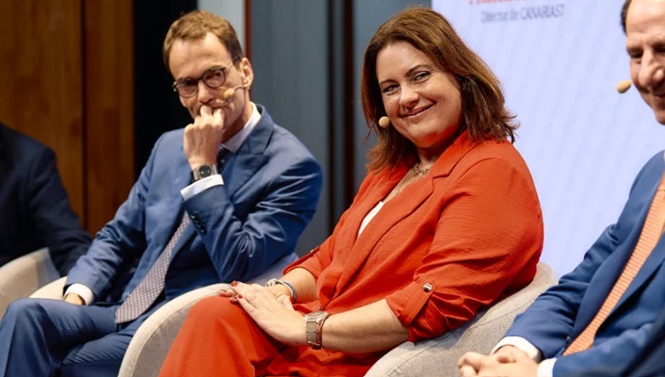
The political isolation of the president of the Port Authority of Las Palmas, Beatriz Calzada, has deepened following the refusal of the main business associations in the sector to come to her defense. Supplier entities of the Foundation Ports of Las Palmas that operate within the orbit of Fedeport and the Maritime Cluster of the Canary Islands — organizations that share executives and overlapping interests — have opted for a strategic silence in the face of the devastating latest audit from Ports of the State. The defensive paralysis of these business associations highlights their fear of being dragged into an oversight file that points to severe distortions in the rules of free competition within the port area, using the social arm of Ports of Las Palmas as a blocking lobby. Fedeport is chaired by José Juan Socas, a port service manager, and its manager is Elba Bueno, who is also the manager of the Maritime Cluster of the Canary Islands. This cluster is presided over by Germán Suárez Calvo, sole administrator, not president as insisted by the island media, of Astican, the island subsidiary of the Greek Laskadiris Group. This entire environment has created a monetary osmosis within the Foundation Ports of Las Palmas to maintain and consolidate its structures.
The trigger from ‘Canarias7’ and the management crisis
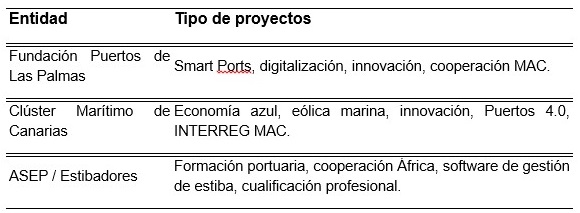
The business associations’ dissociation coincides with a leak in the local press (Canarias7) revealing that Calzada is considering the sudden dismissal of the manager of the Foundation in an attempt to stop a crisis of institutional credibility that threatens to erode her last supports within the Canary Coalition. However, sources from the sector warn that the measure comes too late. The audit from Ports of the State has exposed a consolidated establishment that allegedly instrumentalized a non-profit entity to divert liquidity flows towards related corporate and union organizations. State technicians are demanding a structural dismantling of this framework, a scenario that has pushed Fedeport to operationally mutate towards the Technological Cluster of the Canary Islands in order to continue attracting European funds from the MAC program without raising suspicions.
The bottomless pit of Interreg MAC projects
The main focus of reputational and financial risk is concentrated on the block of European aid managed by the Foundation, totaling 3.04 million euros. Programs like CLUSTERING (2016-2019), the digitalization platform 4p0rt (2019-2023), and the current Blue Supply Chain (2025-2027) served as formal cover to channel resources towards consultancies, travel, and training programs in Senegal and Mauritania. These funds ultimately financed high fees of up to 10,000 euros for teaching services provided by executives from the stevedores’ union and sectoral employers, systematically bypassing ordinary contracting channels and qualified academic centers on the islands.
The hidden subsidy that does not stop technical bankruptcy
The legal viability of the model collapses when analyzing the ordinary support scheme of the institution. Ports of the State revealed that the Foundation remains afloat thanks to a covert public subsidy of 300,000 euros annually derived from the free lease of a heritage building of the Port Authority. Despite this shield of public money, the management accumulated a net deficit of 266,776.21 euros between 2024 (-138,660.30 euros) and 2025 (-128,115.91 euros). In that building, two patrons of the Foundation are present: the employers’ association Fedeport and the Cabildo of Gran Canaria with the SPEGC.
Criminal vulnerability in the face of imminent political change
Calzada’s decision to delay measures against the patronal mechanism surrounding her places her in a position of extreme criminal vulnerability. In the port community, it is taken for granted that a future political change at the port terminal will lead to a massive opening of files. This judicial scenario directly threatens to reactivate old investigations into alleged corruption that have already shaken stevedores, officials, and managers of the Las Palmas terminals in the past, breaking the silence pact that currently prevails at the dock.







