




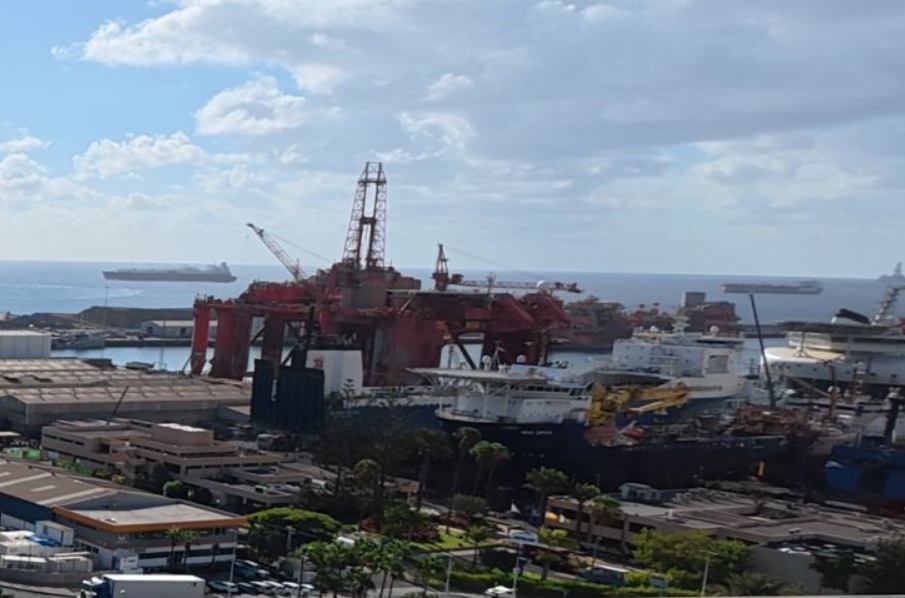
How is a 480 million euro vessel financed by Japan and managed by Australian interests docked in Gran Canaria to map the Tropic Mountain? We analyze the logistical impunity of Astican (Laskaridis Group) and the Anglo strategy to displace the EU in the delineation of the Canaries’ median line.
There is an image that summarizes the current strategic defenselessness of the European Union: the Hassan Marrakchi, the 480 million euro vessel designed to seize scientific control of the Tropic mountain from Spain, is undergoing its final adjustments in the heart of the Port of Las Palmas. The operation is taking place at Astican, the shipyard that, far from local hands, is owned by the Greek giant Lavinia (Laskaridis Group). It is the complex web of interests where the logistics of Las Palmas supports the sovereignist advance of Rabat, orchestrated by Pacific and Commonwealth powers.
This scenario is not just a commercial curiosity; it is the Gordian knot of why Anglo-Japanese power currently dominates the narrative of the seabed off the Canary Islands. The Laskaridis Group, one of the powers in global shipping and cargo, which would utilize Las Palmas in the Falklands War circumventing Spain’s neutrality, has had a 25% share of the supply business for Falklands vessels since 1987, among others, operates under a logic of transnational profit. For the Laskaridis family, the fact that the Moroccan vessel is mapping the tellurium that Spain claims as its own is irrelevant compared to the operational efficiency of their shipyards.
Here lies the first great contradiction: Spain cedes the sovereignty of its strategic shipyards to Greek capital (Lavinia), which, in turn, services the ‘scientific weapon’ of Morocco. The Anglos (British) prefer this model: a logistics infrastructure on Spanish soil that, by being foreign-owned, imposes no ethical or political barriers to Rabat’s ambitions. The profitability of Astican for the Laskaridis Group is unquestionable, but its role as the logistical facilitator of the Hassan Marrakchi underscores Madrid’s loss of control over its own strategic assets. In the battle for rare earths, Anglo power commands the ship, Japan supplies the compass, and Europe simply foots the workshop bill.
Morocco acting as the ‘neighborhood watchman.’
The Anglo power aims to have marine resources charted to ensure in the future that mining rights (tellurium, tin, cobalt) will be within their orbit knowing that Morocco, once its maritime border is consolidated thanks to this vessel, will be a much more compliant partner than Brussels when it comes to sharing the benefits of the subsoil.
That the Hassan Marrakchi chose a Greek shipyard with a Canary name and a past of Spanish state ownership is because it does not want traditional French suppliers to have knowledge of its technological uses. What they call ‘repairs’ in Las Palmas is not by chance. Conducting it in a Greek-owned shipyard adds a layer of diplomatic protection. If the shipyard were public or of purely Spanish capital, social pressure regarding the maintenance of a vessel that ‘steals’ territory would be unbearable. Being in the hands of Laskaridis, the operation reduces to a private commercial transaction, shielding the ship’s mission from any interference from the Kingdom of Spain.
The technical checkmate
While Laskaridis employees adjust the propellers of the Hassan Marrakchi in Las Palmas, Toyota Tsusho engineers study the calibration of sensors that will identify the wealth of the Tropic Mountain. The Anglos have executed the perfect move: a ship built in Japan, operated by Morocco, repaired by Greeks in Spain, and financed to secure resources that will end up in the hands of Australian and Swiss corporations. The Port of Las Palmas, under this perspective, functions as a convenience hub for a strategy of scientific plunder where Spain provides the dock and Morocco takes the treasure map.
Article written by Pedro Marrero. Edited and verified by José L. Jiménez. Cross-checked information without institutional filters. This analysis has not been funded by official advertising nor conditioned by lobbying interests.
Note to the reader: The role of Laskaridis Group from Las Palmas in the Falklands War is pending confirmation—as we are studying it—as previously reported by the Senate of Argentina. It has yet to be verified whether it sold cabotage services to the United Kingdom’s Navy from Las Palmas during that period, where 74 Spaniards lost their lives and where Spain opted for neutrality.







