




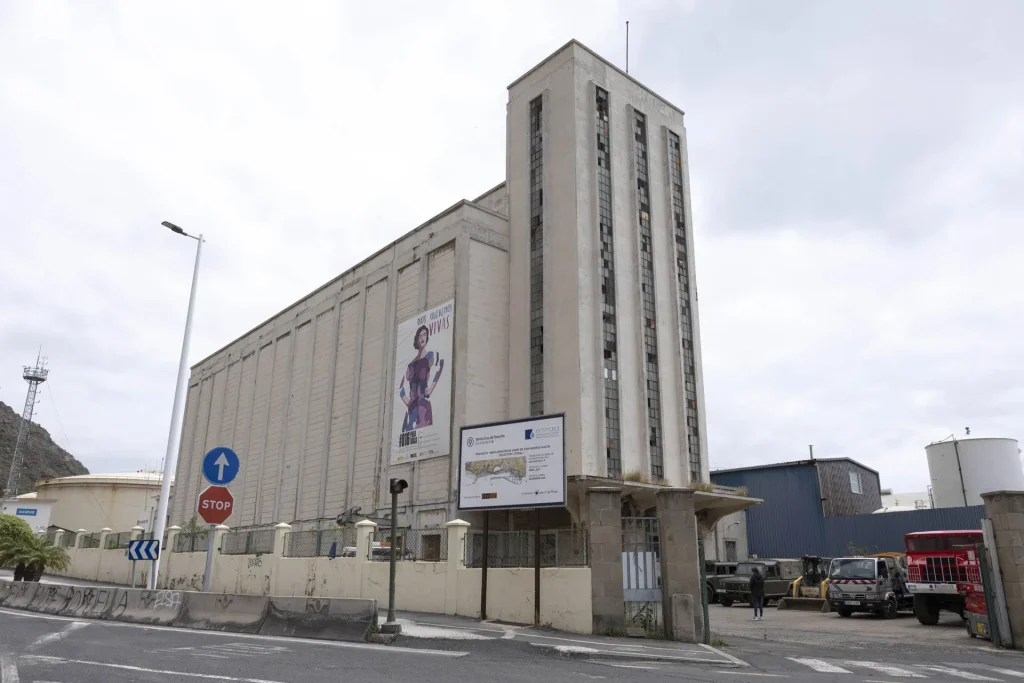
An absurdity. Because one thing is that it is a usable facility as has occurred with the Silo of the port of Oslo and another that nobody wants to exploit the facility and it is going to be left to rot, rendering that space useless for decades to come. What are they going to do, a museum in the middle of an industrial business?
The old grain silo of the Port of Santa Cruz de Tenerife has transitioned from being an infrastructure sentenced to dismantlement to becoming an asset protected by the State. The Ministry of Culture, under the influence of the Podemos faction in the central government, has formally initiated the proceedings to declare the property a Cultural Heritage Asset (BIC) in its category of industrial heritage. This administrative maneuver, recently published, grants the building the maximum protection provided by Law 16/85 of Spanish Historical Heritage, which effectively halts any demolition attempts by the Port Authority of Santa Cruz de Tenerife.
The protection file arises as a direct response to the decision made last September by the Board of Directors of Ports of Tenerife, which had approved the demolition of a structure that has been unused for 35 years. The pressure exerted by the Department of Culture of the Canary Islands Government and the College of Architects found a response in Madrid, where the Ministry has opted to safeguard what is considered the only preserved example of a port-type silo in Spain. The strategic location of the property, next to the East Pier, now places it at the center of a dispute between port industrial operability and historical conservation.
The initiation of the BIC file provisionally applies the maximum legal protection, turning the silo into an ‘untouchable monument’ for the duration of the administrative process. For the sectors that promote the commercial development of the port, the decision is perceived as an intrusion from Madrid that blocks the modernization of the waterfront and the reuse of the land for more profitable activities. Conversely, from the conservationist sector, the move is celebrated as a victory against ‘architectural amnesia’ and an acknowledgment of the value of the industrial legacy of the 20th century.
By elevating the protection to a national scale, the Ministry removes decision-making authority regarding the future of the parcel from local and insular administration, linking any future intervention to the strict restoration and conservation criteria of the State. The building, once a symbol of the food logistics of the archipelago, remains standing as a protected vestige, forcing Ports of Tenerife to reconfigure its expansion plans in an area where the industrial concrete of Podemos has won the battle against the interests of demolition.







