




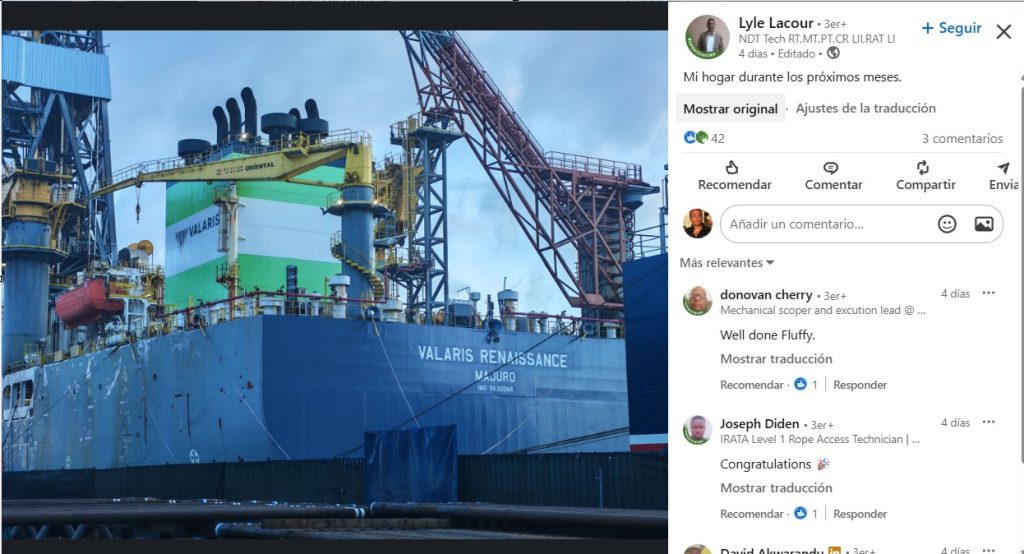
The naval engineering sector in Las Palmas is utilizing the incentive of the ZEC and aid from the Cabildo of Gran Canaria to finance its base structure, while entrusting high-value operations to non-EU specialists. Corporate social networks have revealed a gap in the human resources strategy of naval engineering in the Canary Islands. The announcement on LinkedIn by Lyle Lacour, a specialist in non-destructive testing (NDT), confirming his relocation from South Africa to the Port of Las Palmas to join Global Riser in February 2025, comes at a time of heightened sensitivity. The Labor Inspection has intensified its oversight of non-EU labor in the port area, seeking to curb the importation of profiles that could be filled by local personnel.
Global Riser operates through a dual structure: the general regime and a strategic subsidiary under the Canarian Special Zone (ZEC). This regime, a state aid authorized by Brussels, demands the creation of real and resident jobs in exchange for a corporate tax rate of 4%. However, the mobility of technicians from South Africa challenges the ‘economic substance’ that the Tax Agency and the European Commission require to validate these tax benefits.
Subsidies for local ‘anchoring’
While the company mobilizes talent from the southern hemisphere, it does not neglect the utilization of public resources from the islands. According to treasury subsidy records, the group has shown remarkable agility in securing funds from the Cabildo of Gran Canaria. Specifically, it has secured three grants of 9,000 euros each (reference 749289GC) aimed at hiring hard-to-employ job seekers.
These aids, distributed between late 2024 and early 2025, amounted to 18,000 euros for Global Riser SLU and 9,000 euros for its subsidiary Vestrel TBC SL. The mechanism forms a perfect optimization circle: Canarian public money finances the minimum employment structure that the law requires to maintain the ZEC status, while the actual operations on oil platforms rely on imported technicians.
The Brazil-Canaries Axis
The governance of this network reveals a transatlantic interconnection. In the ZEC subsidiary, Vestrel TBC, Jaqueline Alejandra Mansilla appears as a joint administrator. Trained at John F. Kennedy University in Argentina, Mansilla combines the commercial management of the group in Rio de Janeiro with the management in Las Palmas. This dual leadership reinforces the nature of the company as an optimized cost center that uses the Canary Islands as a staging ground between South America and Africa.
The administrative metamorphosis of these entities has been constant. On November 8, 2023, Vestrel TBC abandoned the single administrator model—formerly held by Jason Frederick Fowkes—to establish a joint board alongside Jorge Sánchez González and the aforementioned Mansilla. This change aims to enhance operational agility in a sector where repair contracts for drilling vessels require an immediate response.
The genealogy of this international holding in the islands solidified in August 2015, when the termination of local administrator Rafael García Cabrera paved the way for the entry of the Australian giant First Subsea Services -pty-ltd-. Since then, the group has been able to understand the advantages of the Port of Las Palmas not only as a mechanical workshop but also as a tax haven. The paradox lies in the fact that while the company expands into high-complexity repairs, the ‘fine print’ of its success rests on 9,000 euro subsidies for hiring hard-to-employ local staff, while specialized engineers fly in from South Africa, and the specialized workforce from the islands is not utilized.







