




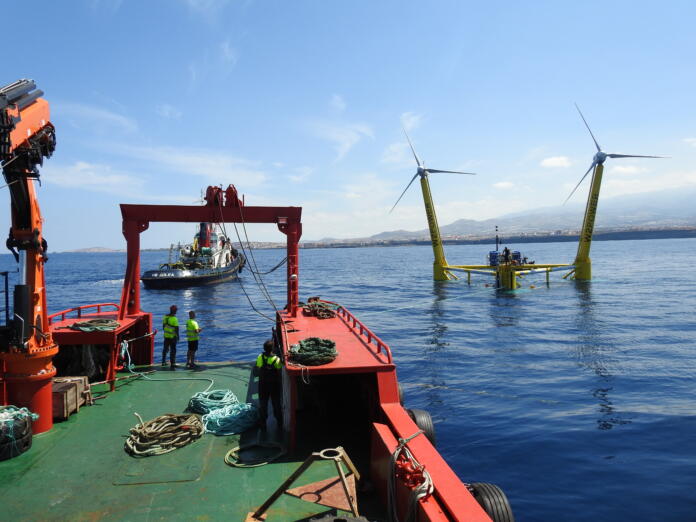
The municipality of Granadilla de Abona is moving forward in its ambition to become a leading port logistics hub, and offshore projects are already beginning to appear on the horizon. The official announcement by the Government Subdelegation in Santa Cruz de Tenerife, published on Wednesday, March 4, 2026, marks the beginning of the public consultation period for the Primavera offshore wind farm. With a budget of €40 million and an installed capacity of 11 MW, the project aims to test the technical and environmental viability of wind technology in deep waters. It is assumed that Enercon turbines will be used, given the area’s prevailing low-level wind conditions.
Granadilla is a port in expansion with ambitions of becoming a logistics and ship repair hub. Installing an offshore wind farm directly within its area of influence—with its 20 kV submarine-to-underground evacuation infrastructure—would impose limitations on land use and maritime space. For the Port of Tenerife, it could become an obstacle to future expansions or to the anchoring of large vessels; for the wind farm, the port itself becomes an obstacle due to operational interference.
Financial business
Investing €40 million to generate just 11 MW is, on paper, a blatant inefficiency. In modern offshore wind, profitable projects typically exceed 200 or even 500 MW in order to dilute the extremely high costs of maritime logistics, submarine cabling, and maintenance. Primavera is a micro-project carrying the fixed costs of a giant with the revenues of a dwarf. For a pure investor, this is not a power generation infrastructure—it is an expensive prototype.
To install only 11 MW—roughly the output of just two modern onshore wind turbines—the company must go through the same bureaucratic ordeal of prior administrative authorization, environmental impact assessment, and public consultation as a 500 MW project. The opportunity cost is evident: while EnerOcean (the parent company of Mayorga Rubio and Fairtlough) spends years navigating paperwork for 11 MW, markets in Scotland or Denmark are deploying gigawatts. For the administration, managing this file consumes almost the same resources as a large-scale project, effectively becoming a drag on the system’s agility.
Technology
Behind Primavera Offshore Wind, S.L. is EnerOcean SL, an engineering firm based in Las Palmas with €3,000 in share capital that has managed to assemble a board with an international outlook. Under the leadership of Pedro Miguel Mayorga Rubio as CEO and with figures such as Alexander Eric Fairtlough and Jan Erik Hanssen on the board, the company is betting on an evacuation infrastructure that will connect the offshore wind turbines directly to the medium-voltage line of the Port of Granadilla. This connection scheme is critical: the project’s efficiency depends on minimizing load losses during its submarine-to-underground transmission to a 20 kV substation.
The administrative process, however, is now entering its most delicate phase under the scrutiny of the Ministry for the Ecological Transition. With the application for prior administrative authorization and the environmental impact assessment on the table, a thirty-day period for objections has opened—one that will test the balance between industrial interests and the preservation of the marine ecosystem in southern Tenerife. For the sector, Primavera is more than a generation plant; it is a €40-million strategic asset that will measure the temperature of legal certainty for foreign investment in Spain’s renewable energy sector. The structure of EnerOcean, with Francisco Solchaga López de Silanes as secretary and a management team that includes Ana Isabel Mayorga Rubio, reflects a professionalized organization seeking to navigate the complex state bureaucracy, while the Directorate-General for Energy Policy and Mines acts as the deciding authority.







