




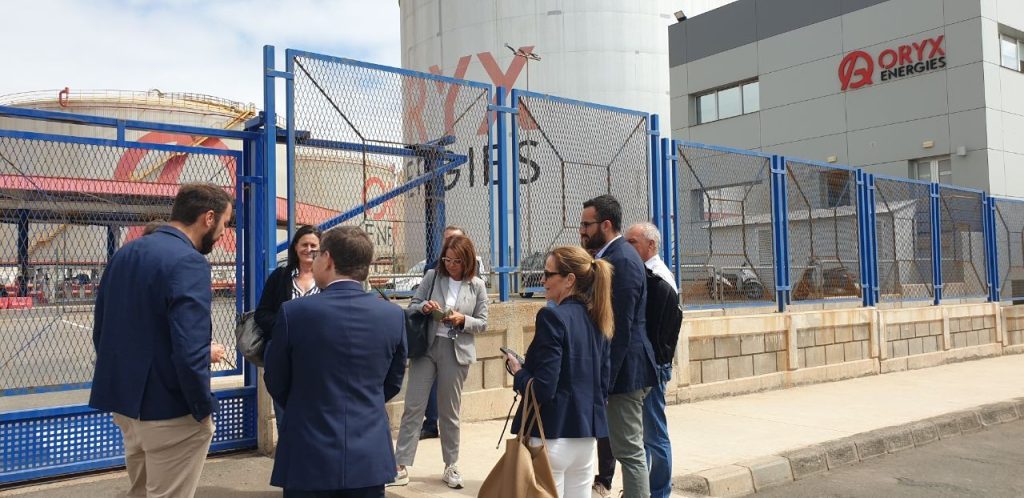
The Minister of Energy and Petroleum of Mauritania, Mohamed Ould Khaled, stated that there is no need to review the country’s hydrocarbon reserves supplied from sites such as the Port of Las Palmas through Oryx Energies, which holds the supply contract, despite the crisis involving Iran, as these reserves are secure and sufficient. He affirmed that there were no supply problems for energy products. During the press conference following the Council of Ministers meeting, Ould Khaled explained that the government had taken measures to guarantee the availability of energy products and to monitor stock levels in light of international geopolitical developments.
He added that specialized committees had been established to monitor reserves of basic goods, including energy products, as part of preventive measures aimed at ensuring market supply. The minister indicated that the government is also working to strengthen storage capacity, having increased storage capacity in Nouakchott by around 23,000 cubic meters, from 60,000 to 83,000 cubic meters, with plans to increase it in the future to around 183,000 cubic meters.
The fuel market in Mauritania has awakened to a dual reality that has left the country’s strategic sectors stunned. On March 4, the price of diesel recorded a significant jump, rising from €1.01 (46.8 ouguiyas) to €1.10 (51.12 ouguiyas) per liter. In a counterintuitive move, gasoline moved in the opposite direction, dropping from €1.22 (56.64 ouguiyas) to €1.11 (51.2 ouguiyas). So far, the official silence of the authorities regarding these fluctuations has fueled uncertainty.
These variations are not coincidental. They occurred just days after United States and Israeli attacks against Iran put the stability of the Strait of Hormuz at risk, a critical chokepoint through which 20% of global trade passes. However, in the economic circles of Nouakchott, skepticism prevails: many experts argue that current reserves were purchased at prices set before the conflict, suggesting that the adjustment may respond more to a preventive or speculative maneuver than to a real shortage. To place these figures in a regional perspective, while diesel in Nouakchott now stands at €1.10, in nearby ports such as Las Palmas, the average price of diesel has already begun to approach €1.19 this week, highlighting an inflationary pressure that does not recognize borders.







