




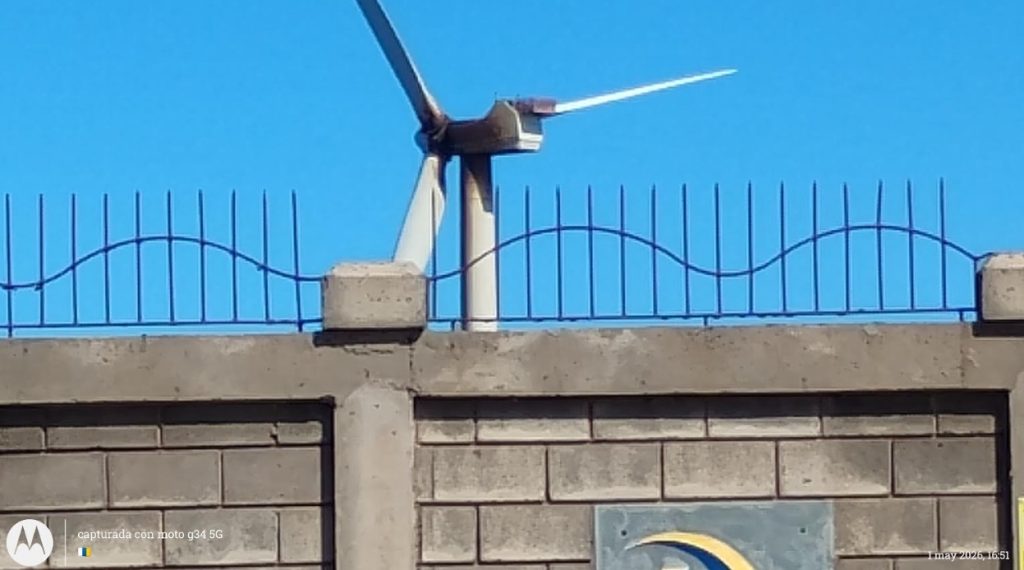
The industrial skyline of southeastern Gran Canaria today presents an image of technological failure. The Gamesa G128-5.0MW wind turbine, the 160-meter giant that in 2015 was touted as the most powerful turbine in Spain and the pride of offshore engineering, has succumbed to a catastrophic fire. The rotor, a structure designed to sweep an area of 12,868 square meters now exhibits a charred black color in May 2026, reduced to useless scrap following a public and private investment of 15 million euros. In 2013, the Gamesa G128-5.0 MW Offshore wind turbine installed at the Arinaga dock in Gran Canaria set the record for electricity generation by a turbine in Spain, producing 3,136 MWh, enough energy to supply over 10,800 homes for a month.
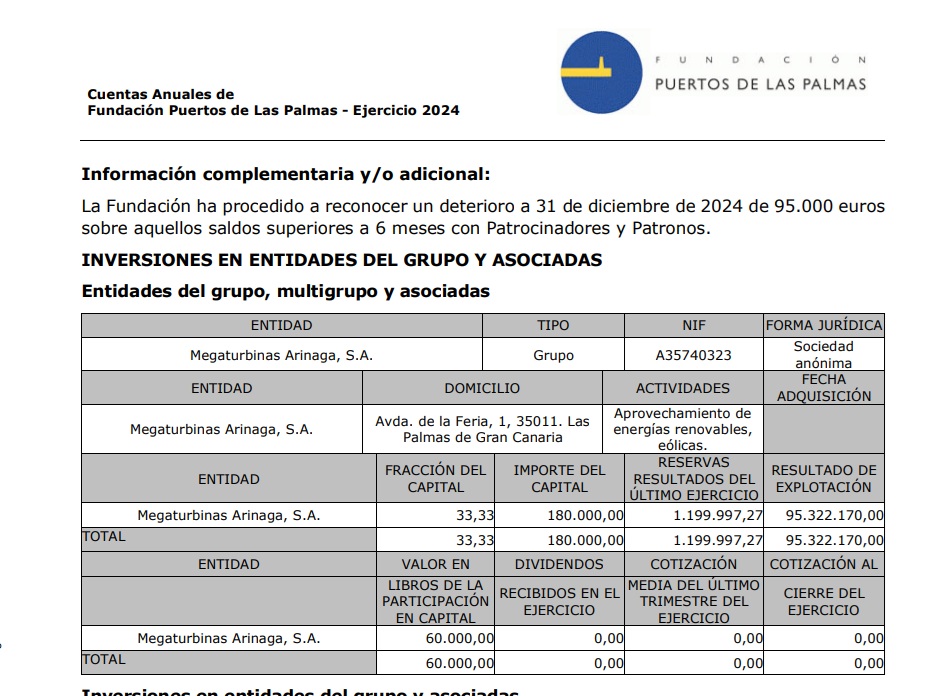
The Ports of Las Palmas Foundation, which owns 33.33% of the Megaturbinas de Arinaga company, holder of the product rights for the Siemens Gamesa project, is now linked to a charred asset that has turned from a global milestone into an industrial skeleton. The company watches as its flagship is knocked out of action, raising questions about the viability of scientific trials at the Agüimes dock. The fire has not only consumed the machinery; it has struck at the credibility of an infrastructure whose power density of 388.6 W/m² promised to revolutionize the offshore sector.
The Foundation’s balance sheet reflects management under pressure as of the end of 2024, recognizing a depreciation of 95,000 euros due to unpaid sponsorships that are over six months behind. While the giant’s rotor is consumed, the financials grapple with a scenario where Megaturbinas Arinaga declares an operating result of 95.3 million euros (perhaps the auditor BDO erred with that figure as it otherwise states 95,000 euros), a figure that clashes head-on with the reality of a 5,000 kW nominal power turbine that is completely inoperative.
The disaster of this unit, equipped with 62.5-meter blades made of fiberglass and carbon, represents a strategic setback for the energy sovereignty of the islands. Designed to withstand peak speeds of 80 m/s and shear winds of 27 m/s, the prototype has failed within its own safety zone. The power exemptions and grid feed-in privileges that this R&D platform enjoyed lose significance in light of a synchronous generator with permanent magnets that today produces only soot.
The image of the blackened hub at 120 meters height casts doubt on the future of Megaturbinas. Without the operation of the ‘mill of 15 million’, the position of Gran Canaria as a scientific referent is compromised. On the brink of a new offshore wind auction, the fire of the country’s largest wind turbine leaves an open wound at the dock and raises a disquieting question about the real return on investment in cutting-edge technologies that end up engulfed in flames.
The General Directorate of Industry and Energy of the Canaries formalized in 2013 the power exemption for the Arinaga project, authorizing the transfer of ownership of Megaturbinas Arinaga, S.A. to Sistemas Energéticos Arinaga, S.A.U. Under file ER12/0018, this resolution provided the legal framework necessary to operate a testing platform for R&D dedicated to multi-megawatt wind turbines. The technical core of this agreement focused on the Gamesa G-128-5MV prototype, a 5,000 kW nominal power infrastructure with a 128-meter diameter rotor and 62.5-meter blades, expressly designed to test cutting-edge technology under real grid feed-in conditions.








Dear José Luis Jiménez or Canary Maritime,
The text currently published conveys incorrect information. This turbine has not experienced any fire incident—the black residue shown is simply grease.
Please correct this as soon as possible and try to be more careful when publishing such information in the future.
Best regards,
Miguel