




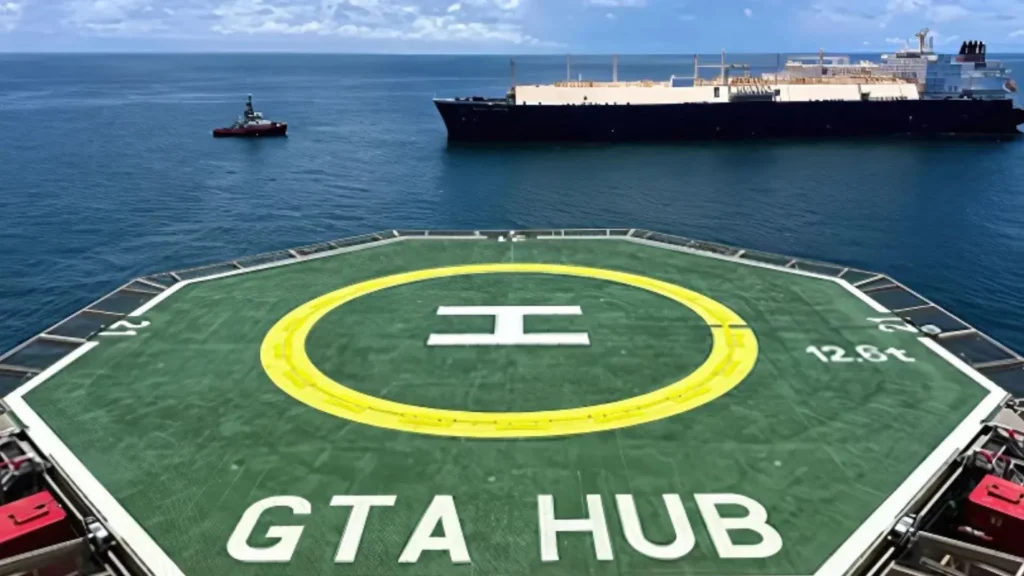
Kosmos Energy issued results on Monday regarding its operations in West Africa supported by technical expertise from companies in the Canary Islands. The company has entered a new phase. After years relying on deepwater oil production in West Africa, it has incorporated structural revenues from liquefied natural gas (LNG) for the first time, thanks to the launch of the Greater Tortue Ahmeyim (GTA) project off the coasts of Mauritania and Senegal. This move diversifies its cash flow during a volatile crude market and strengthens its profile as an integrated Atlantic producer.
The launch of GTA reduces exclusive dependence on oil but also introduces exposure to the LNG cycle. The company currently bets that global LNG demand—particularly in Europe—will continue to provide structural cushioning. Financially, 2025 has not been a year of aggressive expansion but rather of consolidation. With extensive assets in Ghana and Atlantic gas already in production, Kosmos positions itself as a diversified midrange operator along the Africa–America axis, less vulnerable to a single market and more exposed to global energy dynamics.
In 2025, the company reported total sales of 22.4 million barrels of oil equivalent (MMBoe), with revenues of 1.288 billion dollars—approximately 1.190 billion euros at current exchange rates—and an average realized price of 66.89 dollars per barrel. This figure reflects a transitional year: stability in oil, gradual incorporation of LNG, and financial discipline following several years of intensive investment.
The operational milestone occurred at the beginning of 2025 with the first LNG export from GTA. Throughout the year, 18.5 gross cargoes of gas and one cargo of condensate were dispatched. The floating liquefaction vessel Gimi (FLNG) reached its nominal capacity of approximately 3 million tonnes per annum in December, consolidating phase 1 of the project as a new recurring source of income. A long-term sale and purchase contract with BP Gas Marketing provides commercial visibility to the volumes.
The proven reserves at the end of the fiscal year stood at 249 million barrels of oil equivalent, including 120 million barrels of liquids and 770 Bcf of natural gas. The total volume is slightly lower than the previous year, reflecting technical adjustments in Equatorial Guinea and assets in the Gulf of America, as well as the transition of GTA from development phase to production.
Meanwhile, Ghana continues to be the group’s oil anchor. The extension until 2040 of the licenses for the Jubilee and TEN fields clears the regulatory horizon and enables planning for new development drilling. For Kosmos, the extension reduces country risk in its most profitable asset and ensures continuity in a jurisdiction where it already has established infrastructure and operational expertise.
The company closed the year with approximately 342 million dollars (around 315 million euros) in liquidity, supported by an active hedging program and a strategy of gradually reducing leverage. Environmentally, it maintains its goal of operational neutrality in Scope 1 and 2 emissions, along with additional cuts in emissions attributable to its asset participation. The strategic equilibrium is: oil in Ghana as a stable cash generation base; gas in Mauritania and Senegal as a growth vector; and selective development in the Gulf of America, with discoveries such as Winterfell and Tiberius still at different maturation phases.







