




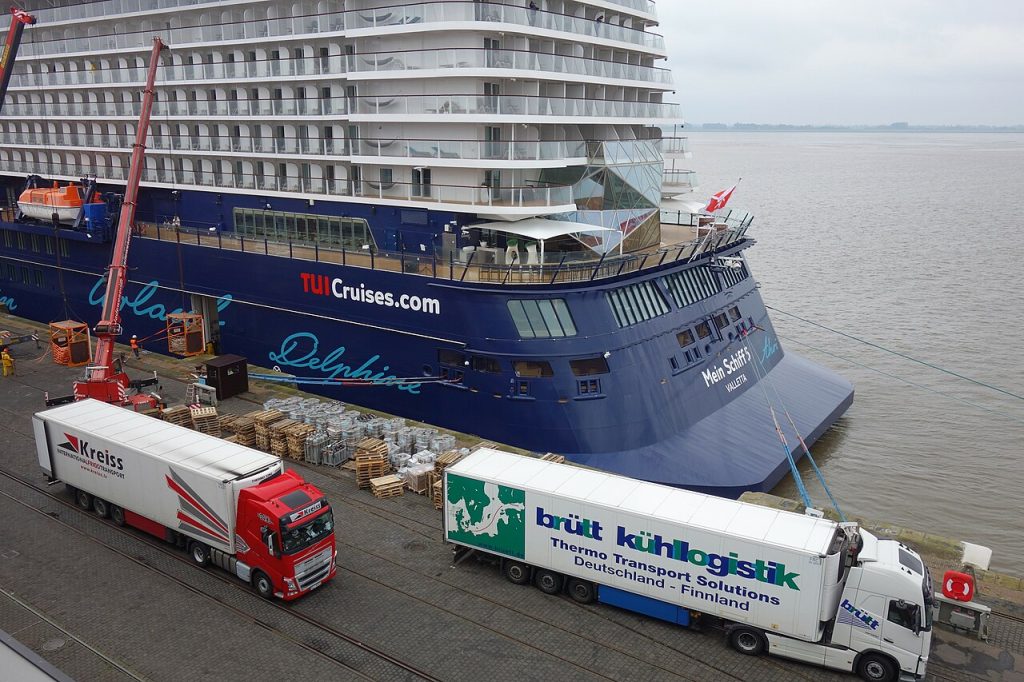
The chronic instability of the Middle East has taken a tectonic turn, transforming the cruising paradise in the Gulf into a low-intensity war zone. The impact of drones near the Mein Schiff 4 and Mein Schiff 5, coupled with the blockade of the MSC Euribia in Dubai, has not only left 30,000 German tourists trapped in a logistical limbo but has also triggered a rebound effect that would place the Canary Islands at one end, not at the center, of the global maritime board. What is an exodus for the Persian Gulf is shaping up as a forced reconfiguration of the season for the islands. But it would have no impact on the island ports.
It was expected that the Mein Schiff 5 would start its journey around Africa to Europe on March 10 from Doha and on March 12 from Dubai, with the first leg heading to Cape Town. TUI Cruises plans to depart the region for Mein Schiff 4 only on March 22, also with a journey around Africa starting in Dubai and with a first leg to Cape Town.
The abrupt cancellation of itineraries by giants such as TUI Cruises and MSC is not an isolated incident; it is the symptom of a region that has moved from ‘unstable’ to ‘operationally unviable.’ With the closure of airspace and key airports, the German Travel Association (DRV) is already coordinating mass repatriations, while shipping companies desperately seek safe ports to reposition their assets. In this scenario, the Canary Islands emerge as the unintended beneficiary: a ‘crisis exclusion zone’ with infrastructures capable of absorbing vessels fleeing the Red Sea and the Strait of Hormuz.
For the ports of Santa Cruz de Tenerife and Las Palmas, the effects are expected in three critical areas. First, a short-term overcapacity of berths. Shipping companies that previously avoided the long route around the Cape of Good Hope are now compelled to circumnavigate Africa, turning the islands into the mandatory technical stop for fuel and supplies. Second, an increase in last-minute tourist demand: with more than a dozen countries under travel alert by the German Foreign Office, the flow of European cruise passengers will be massively diverted towards the Atlantic corridor, now perceived as the only refuge of stability for the winter market.
However, the outlook is not without clouds. The saturation of air connection hubs, as seen with Etihad’s cancellations in Sydney, will affect the connectivity of passengers flying to the islands to embark. Moreover, the pressure on insurance premiums and the cost of bunker fuel—soaring post-drone attacks—will increase operations worldwide. The Canary Islands are thus preparing for a winter of maximum occupancy, but under the shadow of a global crisis that reminds us that, in the luxury floating industry, safety is the rarest and most expensive asset to manage.







