




What is the use of Canarian labor, with a two-digit unemployment rate as of February 2026, when Southeast Asian labor is available at 0.25 euros an hour? The international agency Jesseena Marine Services, operating under technical license RPSL/MUM/006, it is unclear if it has operational licensing in the Kingdom of Spain, has triggered a storm of activity in the Port of Las Palmas by urgently seeking personnel. This situation is a cancer at the Port of Las Palmas: ship repair operators who allow the presence of subcontractors with foreign personnel operating as part of crews. ‘In a facility with PTZ security cameras capable of identifying individuals by facial features, there is a daily influx of Southeast Asian workers operating as labor, and they may have even entered Spain as tourists,’ complains a labor advisor consulted by Canarymaritime. Are they looking for highly qualified labor? No, nothing that a good vocational training in blue economy can provide.
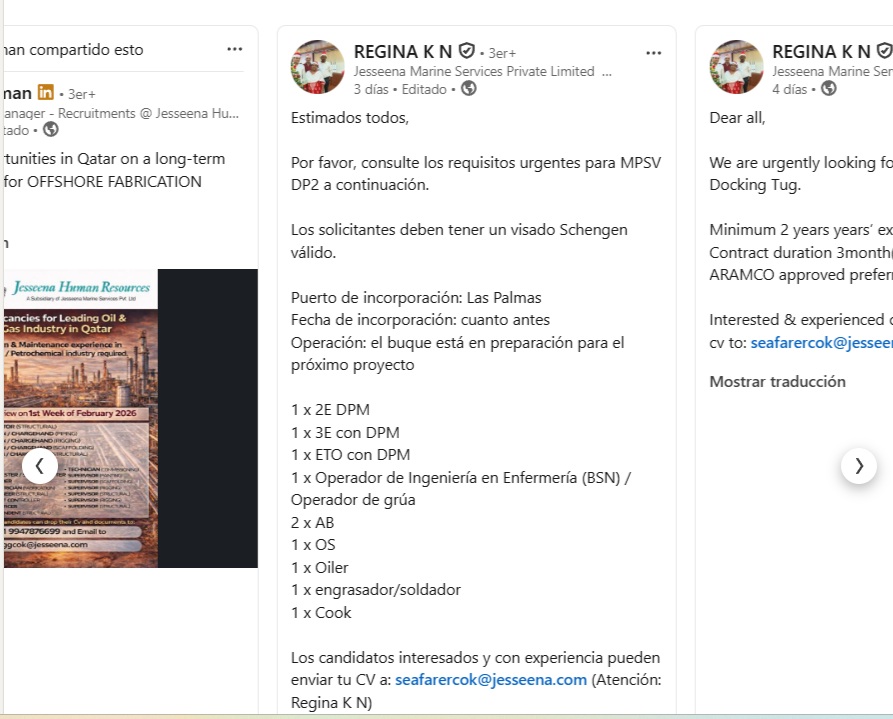
This explains why, when there are workplace accidents resulting in fatalities, there are no trials. In the onslaught of announcements launched last week by Jesseena Marine, it is unknown whether contracted by any unscrupulous ship repair operator, the goal is to complete the crew of a MPSV DP2 vessel (multipurpose support vessel with dynamic positioning class 2), a highly sophisticated technical vessel currently docked in Gran Canaria performing preparation tasks for its next project. The urgency of the mission is reflected in a non-negotiable condition: candidates must possess a valid Schengen visa, allowing for immediate incorporation in Spanish territory and avoiding the lengthy bureaucratic processes that typically delay such operations.
The deployment of vacancies is exhaustive and leaves no room for improvisation, covering key positions for the safety and operability of the vessel. In the engine room, the demand focuses on high-ranking engineers (2nd and 3rd Engineer) and electrical officers (ETO), all of whom must be certified in Dynamic Positioning Maintenance (DPM). Meanwhile, the deck section requires everything from able-bodied seamen and ordinary seamen (AB and OS) to extremely specific roles, such as lubricators with welding certification and crane operators with engineering knowledge (BSN), a mix of competencies that underscores the critical and specialized nature of the work on board.
However, the process has raised eyebrows due to what some perceive as a systematic preference for foreign professionals over Canarian talent. The response to the announcement has been massive, but predominantly international. Individuals from Indonesia or Nigeria reinforce the perception that large offshore shipping companies look to Southeast Asia or Africa before considering the labor market in the islands.
This dynamic has turned the job offering into a global showcase where even external recruiters intervene to redirect the surplus of talent to other energy hubs like the North Sea in the UK. While the docks of Las Palmas are bustling with the arrival of resumes from the Philippines, India, or Nigeria, the debate about the role of the Canary Islands in this industry is reopened: Is the archipelago merely a gas station and logistics workshop for fleets that prefer to import their own cheap or international labor?







