




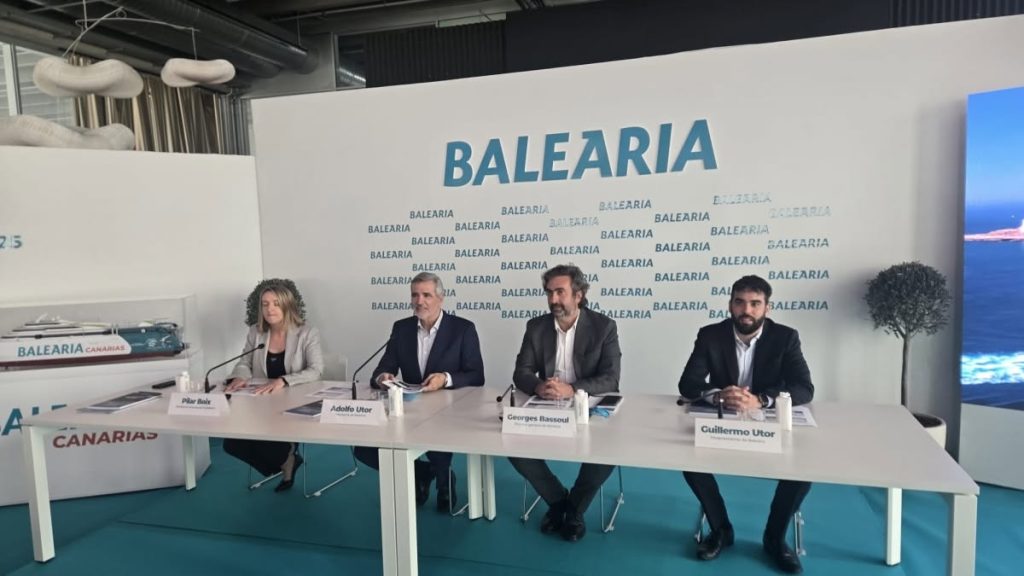
The Official Bulletin of the Commercial Registry has revealed a deep restructuring in two key components of maritime transport in the Archipelago. The Marítima de Barlovento and Marítima de las Islas companies have formalized drastic changes in their executive leadership and corporate structure, consolidating the total control of the Baleària group over its operations in the Canary Islands. This move, recorded on June 11, 2026, ends the tenure of Sergio Vélez as sole administrator of both entities, paving the way for a new era under the leadership of Balearia Canarias Fleetco.
The central figure in this transition is Guillermo Utor Pérez. The executive not only assumes indirect administrative control through the aforementioned companies but also positions himself as the formal representative who will articulate the new strategy of these firms. This administrative simplification maneuver is quite telling: where before there was management embodied in a sole administrator, now there is a corporate structure where the companies act as administrators of other companies, clearly indicating that the Balearic shipping group seeks to secure and centralize its decisions from a purely business perspective.
The revocations of powers are another notable aspect of this package of registrations. Oscar Martínez Huerga, who held extensive representation authority, has lost his powers in both companies. Instead, the group has opted for a trusted team that combines executive profiles with marked specialization in fleet and transport management. George Edward Fuad Bassoul, David Fernández, and Ricardo José Escriche emerge as the new solidary representatives, while Guillermo Utor himself retains joint powers, a legal formula that ensures that no critical decision is made without his direct knowledge or corporate validation.
The metamorphosis extends even to the identity of the single-member companies. The Commercial Registry of Las Palmas details how a transfer in the unique ownership of shares has occurred. In both Marítima de Barlovento and Marítima de las Islas SL, the condition of sole partner has changed, shifting from Balearia Canarias Shipping to Balearia Canarias Fleetco. This change, although it may seem a bureaucratic procedure, reveals an operational specialization: the group is reorganizing its assets where the Fleetco component—often associated with ownership and management of naval assets or fleets—absorbs the definitive ownership of the operators that maintain concessions and the transport business in the Islands.
The impact of this move on the regional market is considerable. Marítima de Barlovento and Marítima de las Islas are well-established names in inter-island and cabotage traffic. The fact that they are now part of such a clearly vertical structure under the group presided over by Adolfo Utor under the Balearia brand confirms that the commitment to the Canary Islands is not temporary but strategic. The unification of the sole partner under the Fleetco branch suggests that the company is preparing to manage its fleet with greater financial and operational autonomy, optimizing the resources of its subsidiary companies in the Canary territory.
The technical complexity of these registral entries, from entry 30 to 34, describes a corporate engineering work executed with surgical precision. It is a process of ‘cleaning’ powers and consolidating command. Old figures are eliminated, and the powers of representation are distributed among several solidary representatives to avoid bottlenecks in daily management, centralizing ownership in the entity that will now act as the operational head of the group in the Canary Islands.
The shipping company has finalized the arrangement of all the pieces of its corporate puzzle in the Canary Islands, preparing for a phase of activity where management will be more professionalized, centralized, and above all, directly linked to the parent company’s fleet strategy. The former companies, now firmly under the control of the new configuration of Balearia, enter a phase where the executive prominence rests with Utor Pérez and a team of representatives who already have the operational challenges of connectivity in the islands on their table.







