




The race for the presidency of the Gran Canaria Chamber of Commerce for 2026 has taken an unexpected turn, abandoning the forecast of a peaceful continuity towards the general director Luis Padrón. The emergence of heavyweight names like Vicente Marrero and José Mayor has activated an electoral stress scenario in Las Palmas that would compel a vote. This movement is not interpreted as a mere dispute for a position, but rather as a strategy to restore business strength against an institution whose funding depends 53% on the Gran Canaria Cabildo and that has seen its influence weakened in critical forums such as the Port Authority. Padrón’s silence regarding business explorations in the Sahara, defended by Fedeport, is what has disrupted the peace of the continuity power scheme that was ostensibly expected.
The return of Vicente Marrero, former leader of Femepa and a key figure in logistics, is shaping up as the response from productive sectors to what they consider an ‘institutional anomaly’: the loss of the Chamber’s seat on the board of the Port of Las Palmas in favor of Fuerteventura. For his supporters, Marrero’s exit from executive circles in 2024 was a tactical error that left the Chamber fragmented and with weakened communication with the port, the island’s largest economic asset. Marrero, currently a member of the plenary, embodies, as said to Canarymaritime by a businessman from the Port of Las Palmas this Monday, the figure of the ‘consensus builder’ capable of centralizing the business voice and eliminating the noise from smaller factions that have gained weight during his absence.

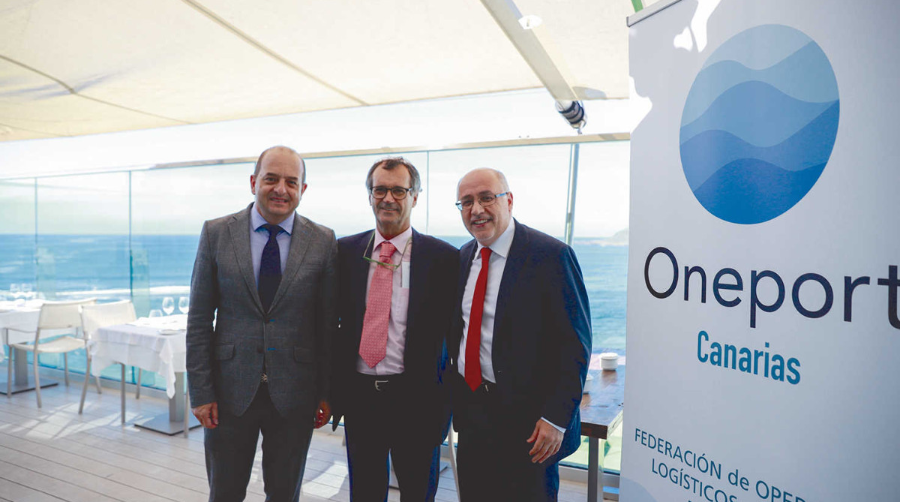
On the other hand, the figure of José Mayor emerges with renewed strength after being ratified as president of Oneport Canarias for the period 2026-2030. His recent consolidation at the head of the federation of logistics operators, supported by relevant figures like Guillermo Ramos (Zamakona) and Javier Delgado (Canarship), provides him with a solid platform based on the defense of the real productive fabric and backed by the Gran Canaria Cabildo. Mayor had already communicated last December to members of the plenary of the Chamber his willingness to step forward, presenting himself as a firm advocate for freelancers and small business owners, whom he defines as the true engine of the regional economy in the face of increasing bureaucratization.
The logic suggests that Mayor wants to occupy centers of power directly in the Port of Las Palmas to legitimize the historical demand of the employers’ association he presides to have seats on the councils of the two Canarian port authorities given that he has regional coverage as well as in the advisory council of Puertos Canarios, where Santiago de Armas sits representing the Gran Canaria Chamber (Lopesan is betting on a future operation with the departure of the Ceisa cement factory from the south of the island and has renewed the concession for Pasito Blanco).
The calendar towards the goal of 2026 has already begun to count down days following the publication of Order ECM/1382/2025 in the BOE. With January 22, 2026, marked as the deadline for census claims, the business sector is racing against time to configure a candidacy that ensures port rebalancing. The objective is clear: to prevent the Gran Canaria Chamber from becoming a divided institution at a time when international operators consolidate their presence in centers of power at the Port of Las Palmas. The 2026 election will determine whether the institution continues under administrative management or recovers a business-oriented leadership aimed at directing the logistical axis of Las Palmas against regional competition.
News written by Pedro Marrero from the newsroom in Tenerife. Edited and verified by Gara Vega in Las Palmas. Cross-verified information without institutional filters. This analysis has not been funded by official advertising nor conditioned by lobby interests.







