




In Norden’s balance for 2026, the Canary Islands do not appear as a direct cargo generator, but rather as a fixed cost optimizer. Without the operational efficiency provided by Tenerife or Las Palmas, the offshore transshipment model in Guinea would lose much of its competitive advantage compared to traditional routes. Essentially, the Canary Islands serve as the insurance policy and technical lifeblood of the shipping company’s African expansion.
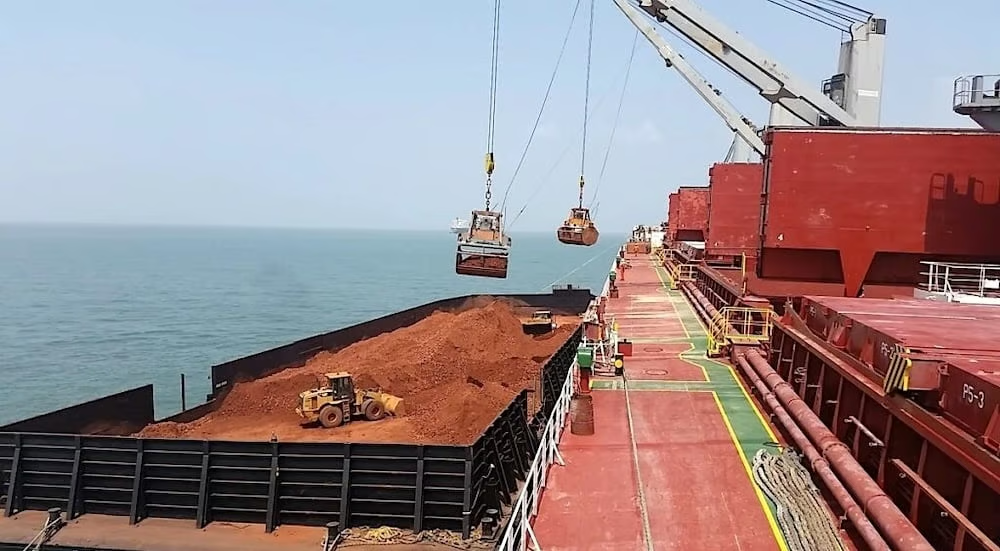
While the global maritime sector grapples with capacity distortions caused by the reopening of Red Sea routes, the Danish shipping company Norden has established its financial center of gravity on the shores of Conakry. Following a strategic positioning in 2025, the Hellerup-based firm enters 2026 transforming the Guinean extractive model through an ambitious contract for integrated services with Africa Oil Supply (AOS) for the evacuation of bauxite from Compagnie des Bauxites de Guinée (CBG) to the Chinese market.
The investment thesis of Norden is based on drastic cost re-engineering. By using transshipment stations and floating cranes offshore, the shipping company enables the mineral to reach Capesize giants, eliminating the dependency on smaller draft vessels (Ultramax or Panamax) that weighed down client margins.
Jan Rindbo, CEO of Norden, has designed this move to consolidate long-term revenue visibility, replacing previously fragmented logistics with a ‘turnkey’ solution. This optimization not only reduces freight costs but also aligns the group with ESG metrics, by decreasing the carbon footprint per ton transported thanks to the use of economies of scale in modern vessels.
The structural imbalance of the fleet
The deployment in Guinea occurs at a critical moment for the global supply of ships. According to analysts at MDS Transmodal, the normalization of the Suez Canal has generated a surplus of megaships on East-West routes. In this context, Norden’s strategy of ‘hijacking’ Capesize capacity for the Guinea-China corridor acts as a protective shield against the volatility of medium freights. By focusing its operations on long-haul projects such as bauxite and the imminent Simandou deposit, the Danish shipping company ensures an asset saturation that its competitors, trapped in the imbalance of traditional routes, struggle to achieve.
The Comilog model
Guinea is the second chapter of a script that has already proven successful in Gabon. There, Norden transformed the evacuation of manganese for Comilog (Eramet) using the same system of floating stations. To support this expansion, the group has woven an intelligence network on the ground with new offices in Abidjan and Libreville, in addition to the acquisition of Taylor Maritime in Durban. This infrastructure allows it to manage the three maritime fronts of Africa as a unified logistical ecosystem.
Conakry
The success of Norden’s operations is a cornerstone for Guinea’s macroeconomic aspirations. The country plans to launch its Sovereign Investment Fund in the second quarter of 2026, directly fed by royalties from a mining sector that can now, thanks to Norden’s efficiency, export larger volumes at lower costs. The message is clear: Guinea is no longer just a repository of raw materials but a laboratory where major European shipping companies are testing the resilience of their balance sheets against an increasingly unpredictable global freight market.
News written by José L. Jiménez. Edited and verified by Pedro Marrero. Information cross-checked without institutional filters. This analysis has not been financed by official advertising nor conditioned by lobby interests.







