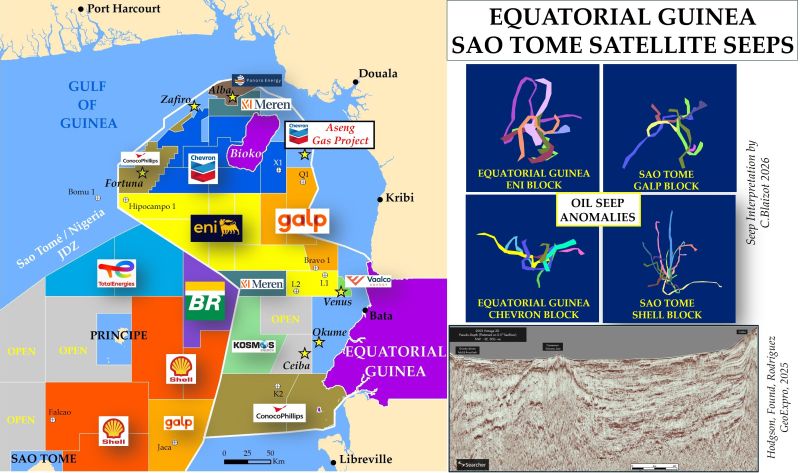
The map of deepwater oil exploration in the Gulf of Guinea is undergoing a massive reconfiguration that defines the offshore dominance positions for the next decade. The multinationals Eni, Chevron, and Galp have closed key agreements off the coast of Equatorial Guinea, practically completing the award landscape of the Central African country. In parallel, the neighboring republic of São Tomé and Príncipe (STP) is accelerating its strategic positioning in the international energy sector with the entry of the Brazilian state-owned company Petrobras, which joins the pre-existing alliance between TotalEnergies, Shell, and Galp.
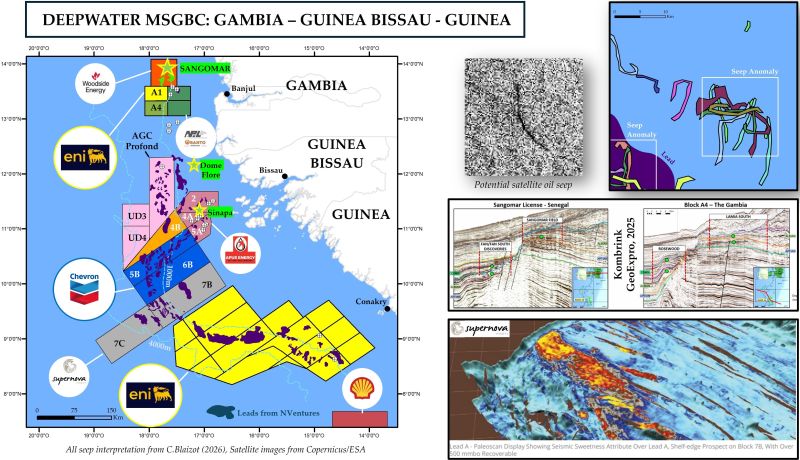
International major operators have returned forcefully to this vast exploration territory that holds massive oil resources, a geological corridor that connects the successes of Woodside Energy and the Groupe PETROSEN in the Sangomar field to the coasts of Guinea. This reactivation of transnational capital will help reinforce the presence of independent and regional players such as Supernova Energy B.V., Apus Energy DMCC, and Atlas Oranto Petroleum in a historic territory where previous commercial milestones were limited to the Dome Flore discoveries and the Sinapa projects by Premier Oil and Occidental Petroleum (Oxy). Throughout the last campaigns, key blocks such as AGC Profond—under scrutiny by Woodside, Impact Oil & Gas, and CNOOC International—as well as the UD3 and UD4 areas operated by Rhino Resources Ltd, have also been the subject of active seismic investigations.
The exploratory offensive in Equatorial Guinea assigns the Italian Eni control of six strategic blocks, while the American Chevron secures five areas and the Portuguese Galp expands its portfolio with three additional blocks. In the northern sector of the basin, ConocoPhillips has taken positions in high geological potential areas by acquiring Block B4—the area of ExxonMobil’s Esmeralda discovery, adjacent to the historic Zafiro field—and Block EG-27, previously operated by Ophir Energy within the Fortuna gas complex. These industry giants will share space with active independent operators such as Marathon Oil, Trident Energy, Gepetrol, and Panoro Energy, a firm that has just formalized the purchase of Kosmos Energy’s stakes in the G and S blocks, reactivating the mature fields of Ceiba and Okume.
For its part, the government of São Tomé and Príncipe is advancing its campaign to attract foreign capital for the development of its ultra-deepwater resources. The technical interest in the basin has solidified after analyses of the Falcao prospect, whose structural indicators determined the recent entry of Petrobras into the drilling consortium. The international customs and maritime transport market remains on standby for the release of the official opinion of the 2026 Bidding Round, which will assign the remaining open blocks (Blocks 7, 8, and 9) located west of Príncipe Island, an area closely monitored by logistics operators due to the distinct oil seep structures detected through satellite imagery.