




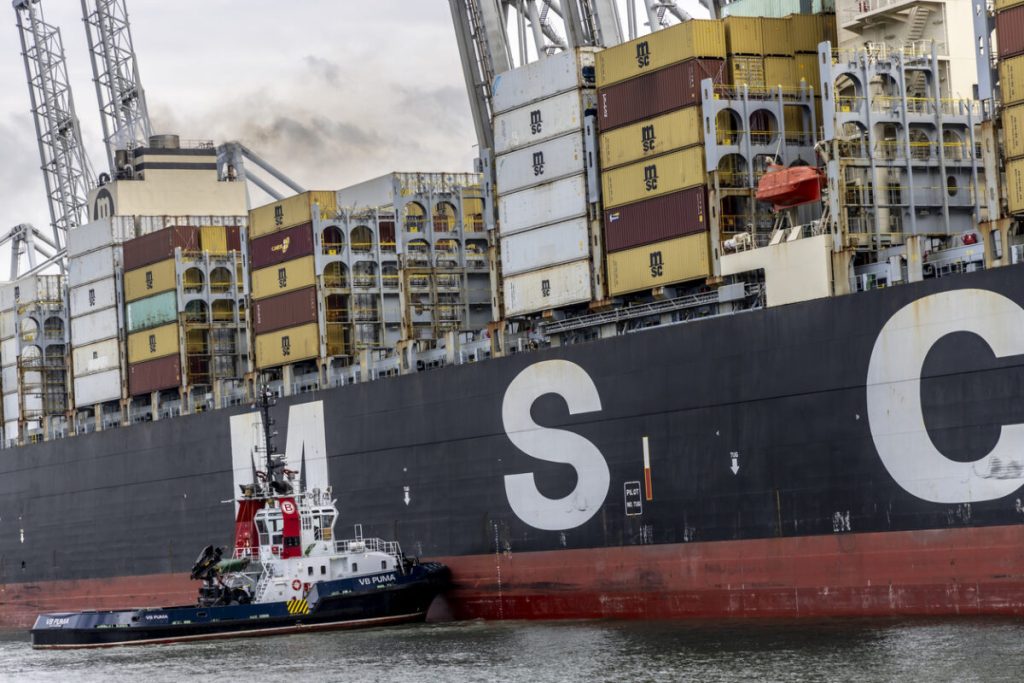
Mediterranean Shipping Company (MSC), the giant of the seas and owner of OPCSA at the Port of Las Palmas, has officially announced the introduction of a significant war risk surcharge for all its operations connecting the Indian subcontinent and the Gulf with African markets and the islands of the Indian Ocean. The decision is not just another administrative procedure; it is a direct response to the increasing insecurity in the corridors of the Middle East that threatens to strangle trade flow at critical points. It has not been officially stated that it affects ‘West Africa,’ and when asked about the Port of Las Palmas, there is no clear response.
For shipments from the Indian subcontinent, MSC will charge 500 dollars per twenty-foot equivalent unit (TEU) for dry containers and 1,000 dollars per TEU for refrigerated containers. Cargoes originating from Gulf countries will cost 2,000 dollars for 20-foot containers, 3,000 dollars for 40-foot containers, and 4,000 dollars for refrigerated containers destined for African countries.
The new cost structure draws an invisible but extremely expensive border for exporters. According to notices sent by the shipping company, any container leaving India, Pakistan, Sri Lanka, or Bangladesh destined for the coasts of Somalia, Mozambique, or East Africa will arrive with an additional bill of 500 dollars for dry cargo and up to 1,000 dollars if the product requires refrigeration. This is the necessary toll for navigating waters where security can no longer be guaranteed through ordinary routes.
However, the real financial blow is suffered by shipments originating in the Gulf region. For these routes, MSC has raised the stakes: the surcharge scales up to 2,000 dollars for standard 20-foot containers and reaches 4,000 dollars for refrigerated units destined for West, East, and Southern Africa. These figures reflect the seriousness of the situation in critical transit areas, such as the Strait of Hormuz, whose potential paralysis has already been pointed out by analysts like Veson Nautical as a real threat to 25% of global oil operations.
This measure positions MSC in a state of alert shared with other giants like COSCO and CMA CGM, who closely monitor the tensions in the straits. The surcharges are not just a way to offset rising marine insurance costs, but an operational defense mechanism in a scenario where global logistics has become a hostage to war tensions. Africa, once again, sees its connectivity with the world becoming more expensive due to conflicts fought far from its ports, but which directly impact the price of every container that touches its shores.







