




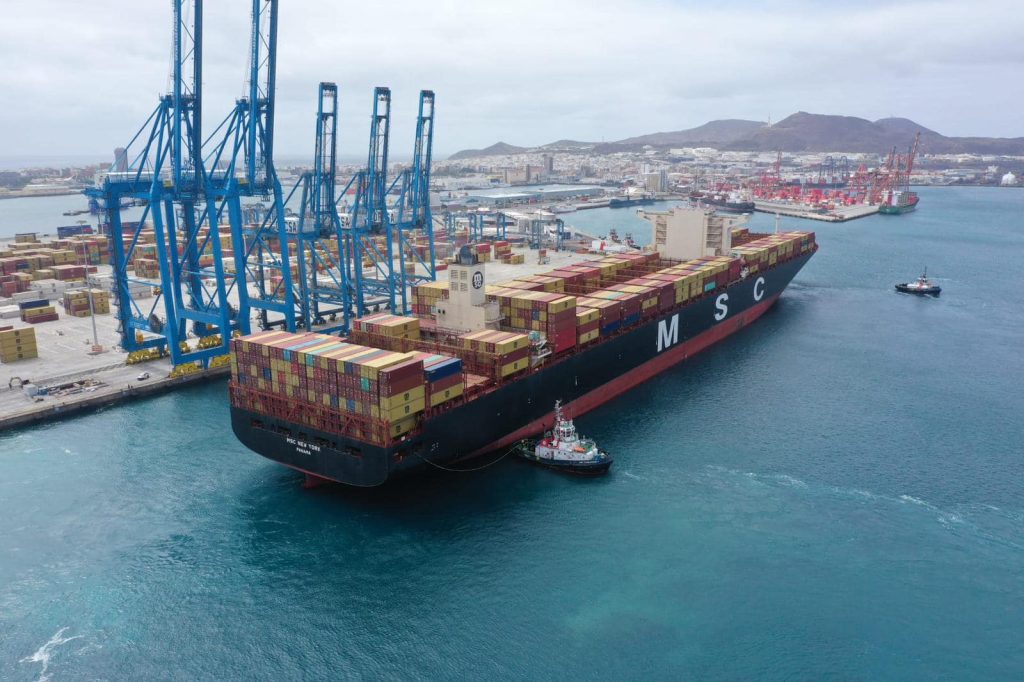
The implementation from 2026 of the private 5G network at the OPCSA terminal, in partnership with Boldyn Networks and Nokia technology, marks the beginning of an era of surgical efficiency at the Port of Las Palmas. In this new scenario, connectivity no longer depends on the rigidity of fiber optics; now, information flows wirelessly to the RTG and STS cranes, located more than 100 meters high, enabling real-time monitoring that minimizes unexpected stops.
Despite the labor issues caused by the presence of the conservative stevedoring sector demanding to maintain agreements from the Franco era, by 2030, OPCSA will have reinforced its terminal at the Port of Las Palmas with the addition of state-of-the-art cranes, including Malaccamax STS gantry cranes for ships up to 24,000 TEU and hybrid RTG cranes from Konecranes, with a total investment exceeding 48 million euros, aiming to increase operational capacity and improve sustainability. However, the movement of TEUs is hindered by the low productivity of the workforce in comparison to the large TIL terminal in Lomé or Sines.
For Jan Nowak, CEO of OPCSA, a subsidiary of TIL participating with MSC, Blackrock, and the Singapore sovereign fund, this project represents a transformative leap that positions the Port of Las Palmas at the forefront of regional port innovation in West Africa. The collaboration with Boldyn and Nokia not only addresses a need for modernization but also lays the groundwork for a smarter and more sustainable logistics hub; however, can one be modern with outdated labor policies in stevedoring, considering the associated costs? It remains a mystery that may be resolved when Dakhla Atlantique begins its operations in the Sahara.
With an agenda and operations already looking towards full performance in 2026, the port is preparing to demonstrate that true competitiveness in the Atlantic is no longer measured solely by the number of port calls, but by the latency capacity of its network and the agility of its algorithms. This network not only optimizes container logistics but also equips operators with digital tools for a much more reliable maintenance and cold chain management, drastically reducing operational costs.
The strategic position of TIL’s subsidiary, connected to over 74 ports worldwide, is enhanced by this technological capability, placing it as the leader in digitalization within the group. By adopting the ‘5G as a service’ model, the terminal ensures a scalable and secure infrastructure, avoiding the complexity of managing the network internally and allowing focus to remain on cargo movement. It is the first step towards the remote operation of cranes, a milestone that promises to forever change the face of port work, replacing traditional mechanical tasks with intelligent management based on telemetry and real-time data analysis.
The CEO of Boldyn Networks in Europe, Mikko Uusitalo, states that ‘this experience makes us exceptionally prepared to offer a transformative private 5G network for OPCSA. We are excited to bring our capabilities to such a strategically important terminal and support its journey towards becoming a smart and fully digitized port.’ For Nokia, this project demonstrates how Nokia’s private wireless connectivity enhances critical operations and lays the foundation for smarter and more sustainable logistics centers worldwide.
News written by Pedro Marrero. Edited and verified by Gara Vega. Cross-checked information without institutional filters. This analysis has not been financed by official advertising nor conditioned by lobby interests.







