




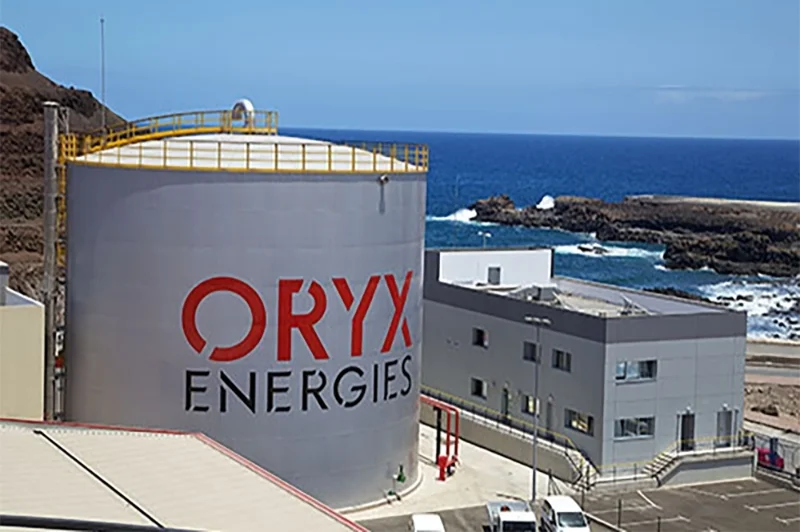
The stability of the hydrocarbon market in West Africa is once again being shaken by the revelation of the financial mechanisms that uphold monopoly positions in the region. An investigation published by the Mauritanian data journalism portal Taqassy Media has uncovered the documents of a strictly confidential settlement agreement signed between the state electricity corporation Somelec and Addax Energy, the commercial subsidiary of the Swiss energy conglomerate Oryx Energies based in the Port of Las Palmas. The pact, sealed with complete discretion, definitively neutralizes a multimillion-dollar lawsuit that was being litigated before the International Arbitration Court of the International Chamber of Commerce (ICC) in Paris, highlighting the considerable resilience of the Swiss operator in the supply chain of the Maghreb.
The logistical shield of the Canary Islands
Independent sector experts and senior government officials defend the continuity of the corporate relationship with Oryx’s subsidiary, arguing that Addax consistently prevails in international tenders due to a significantly superior financial muscle and an unbeatable logistical infrastructure in the Central Atlantic. The key factor in this advantage lies in the proximity of reserve deposits and terminals for crude oil and refined products that the group controls just a few nautical miles away, in the Port of Las Palmas. This logistical enclave in the Canary Islands serves as a base of operations and a permanent distribution center, allowing for risk mitigation against delays and enabling a rapid response to any disruption in the Saharan supply chain that is unattainable for other global operators.
The architecture of the confidential pact
The internal documents obtained by journalist Saleck Zeid demonstrate that the secret agreement protocol was signed under the direct oversight of the National Commission of Hydrocarbons of Mauritania. The architecture of the financial pact involved significant mutual capital concessions to avoid an arbitration ruling with unpredictable consequences. On one hand, Addax Energy agreed to withdraw several claims for accumulated freight payments, while the state-owned Somelec consented to waive a package of penalties for delays in the logistical supply, which had a book value exceeding 23 million dollars.
The exchange of guarantees and credit facilities
The core of the financial swap was structured around a bank guarantee of 10 million dollars that was held by the Mauritanian state and has now been fully returned to Oryx’s subsidiary accounts. In exchange for the release of this guarantee, Addax made a cash payment of 3 million dollars to Somelec and simultaneously granted a series of exceptional commercial credit facilities. Among these measures are extended payment terms for future fuel shipments and the opening of an interest-free current financing line. The entire protocol was secured under a strict legal confidentiality regulated by French private law.
The technical origin of the Paris dispute
The technical root of the legal conflict dates back to the severe energy supply crisis recorded in the Mauritanian market as a consequence of the cargo transported by the oil tanker Nordic Humboldt. The technical management of Somelec publicly reported that the heavy fuel oil supplied in that shipment did not meet the contractual technical specifications, causing severe structural damage to the generators of several power plants in the country. This emergency situation forced the state operator to urgently replace the fuel oil with automotive diesel, drastically increasing operational generation costs and forcing the public treasury to absorb a severe financial overcost.
Cross discrepancies in refining
In contrast to the electric company’s position, the minutes from the Mauritanian Society of Refining Industries (Somir) provided to the investigation reflected an absolute technical contradiction by determining in their own laboratories that the fuel from Nordic Humboldt did indeed meet the stipulated quality standards. These cross-analytical discrepancies fueled accusations of lack of transparency that led to the transfer of the dispute to the international courts in Paris, before both firms agreed on a negotiated exit to protect the continuous supply flow.
A market dominance under suspicion
The outcome of this litigation underscores persistent market doubts regarding the structural influence that the Oryx group, through Addax, exerts in the supply of strategic resources in Mauritania, a sector where it has maintained an uncontested dominant position for over a decade. Sources within the competition and local analysts allege that the Swiss firm enjoys asymmetric competitive advantages in public fuel tenders, achieving profit margins for distribution that they consider disproportionate compared to international contracting standards.
New concessions and strategic shielding
The signing of this secret judicial pact coincided temporally with the awarding to Addax of new large-scale state contracts. The concessions include the exclusive supply of fuels for domestic consumption and the execution of new works for the expansion of the strategic hydrocarbon storage capacity in the port facilities of Nouakchott. While the Mauritanian executive defends these measures as the only way to guarantee national energy security against international volatility, competing firms criticize what they term as the definitive consolidation of a de facto monopoly that restricts free competition in an industry vital to the country’s development.







