




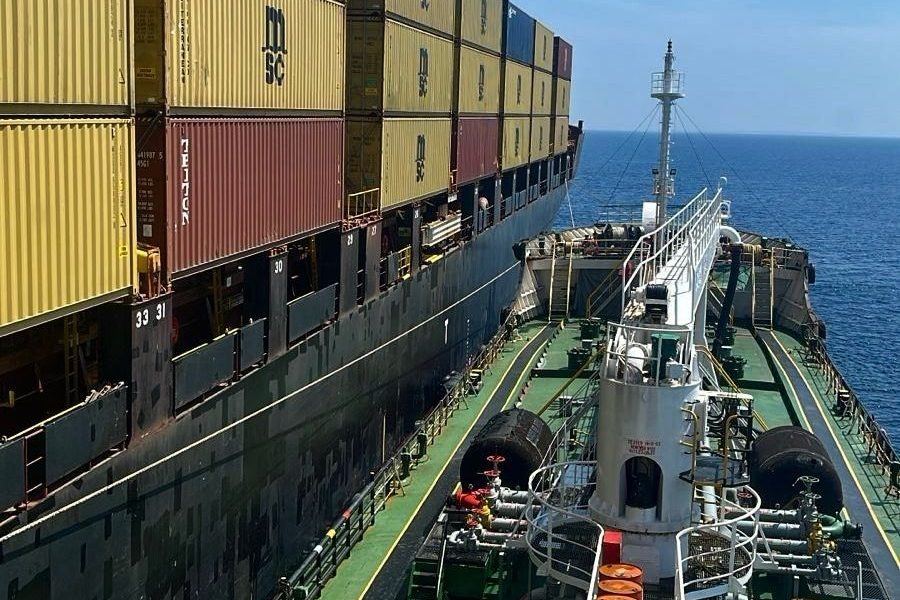
On the dock, the signal is not given by speeches but by deadlines. This week, fuel buyers at the Port of Las Palmas are receiving an unusual recommendation in a market accustomed to agility: to book at least ten days in advance. Availability is limited and premiums can quickly escalate if high demand coincides with bad weather. There is war in the Middle East and this will be a long situation. Peninsula Petroleum experienced this last Sunday when a missile struck one of its vessels, according to Reuters.
The Canary Islands supply center —a key component in the routes connecting Europe, West Africa, and America— is undergoing a moment of logistical friction. Although the price of VLSFO fell by 12 dollars per ton in the last session, pressured by three offers in the range of 490 to 500 dollars per ton, the relief is relative. The shortage of product and the forecast of winds exceeding 25 knots, with strong swells, threaten with temporary suspensions in outer anchorage areas in these early days of March.
The adjustment in Las Palmas contrasts with the uneven evolution in other ports. In Rotterdam, VLSFO rose by one dollar per ton; in Gibraltar, it fell by six. But all this was before the Pentagon started its plan to dismantle the Iranian regime. Durban recorded an increase of four dollars. In the HSFO segment, Durban experienced a jump of 20 dollars per ton, while Gibraltar and Rotterdam corrected downward. The differential matters: sourcing HSFO in the Canary Islands can cost around 15 dollars more per ton than in Gibraltar.
For shipowners diverting routes around the Cape of Good Hope or adjusting stops in the central Atlantic, Las Palmas remains a strategic point. But the balance is delicate. The port becomes more attractive when global diversions increase; it loses competitiveness if local supply tightens and prices exceed those of neighboring enclaves.
In the background, the crude oil market adds volatility. The ICE Brent contract for delivery in March was priced at 71.06 dollars per barrel at 09:00 GMT, after dropping 0.54 dollars in the session. Tensions in the Middle East —with the third round of nuclear talks between the United States and Iran scheduled in Geneva— provide support to the price. Iran, the fourth-largest OPEC producer with about 3.2 million barrels per day, remains a structural risk factor.
The market also digests signals of oversupply. The American Petroleum Institute reported an increase of 11.4 million barrels in U.S. crude inventories last week, far above expectations. A surge of that magnitude suggests weaker demand and exerts downward pressure on Brent, while awaiting official data from the Energy Information Administration. For the Canary Islands, the equation is immediate. The price of bunkers does not depend solely on crude, but on logistics, inventories, and weather. When physical shortages and financial volatility converge, the port becomes a leading indicator of energy trade. In an archipelago where maritime transport is critical infrastructure, the question is not whether there will be tension but how long it will last.







