




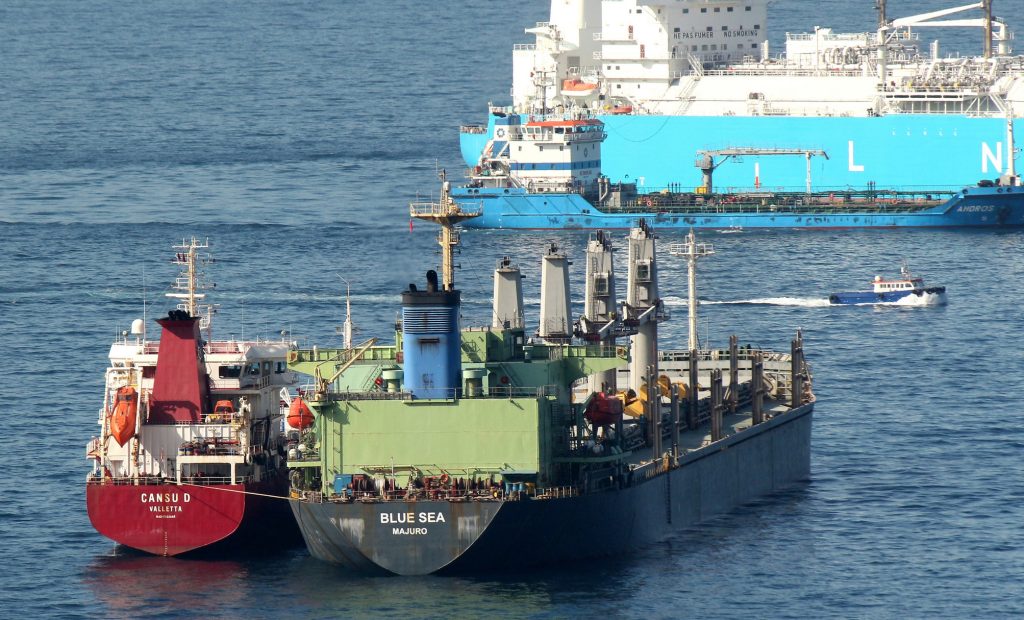
As of January 12, 2026, the bunkering map in the Mid-Atlantic and the Mediterranean is drawing a new hierarchy. While the Strait of Gibraltar is drowning in its own congestion and Northern Europe is entangled in the bureaucracy of ‘green’ premiums, Las Palmas is beginning to see the light at the end of the tunnel, just as the shadow of Dakhla and West Africa lengthens.
Gibraltar: Nine Ships in Line and the Clock Ticking
Crossing the Strait has become a test of patience. With nine ships waiting in line and delays exceeding 24 hours at some suppliers, Gibraltar and Algeciras are dying from success (or a lack of agility). Booking there now requires up to a week in advance to avoid being ‘stranded’ at anchor. This is the ideal scenario for Las Palmas, a traditional competitor, to play its cards.
Las Palmas: Technical Improvement Under the Whip of the Sea
The news for the Port of La Luz is positive, although tempered by meteorological nuances. The availability of fuel (VLSFO) has drastically improved: if last week, 14 days of notice were needed, suppliers now operate with margins of 7 to 10 days.
However, the weather — that capricious ally of geopolitics — is making its mark. Waves over two meters have forced the closure of the outer anchorage, shifting activity to the interior and the dock. In Las Palmas, the hose keeps going, but the delay is the price to pay for safety. Even so, compared to the collapse of Gibraltar or the 10-day wait in Denmark, the Canary port remains the logistical ‘shelter’ of the Atlantic.
The Pinch of West Africa
But one must not rest on laurels. The bunkering chronicle shows that West Africa is gaining traction. In Dakar, VLSFO is now delivered with just 3 to 5 days notice, an agility that Las Palmas still envies. In Durban, availability has improved so much that supplies are almost immediate (2 to 4 days).
The European ‘Tax’: The Final Blow of RED III
While Las Palmas struggles against the waves, Europe is shooting itself in the foot with the RED III Directive. Northern ports (Rotterdam, Antwerp) are already passing on premiums for fossil fuels and costs for flow meter (MFM) investments. This regulatory increase is the best sales pitch Dakhla could have: Who will refuel at a hyper-regulated European port if just a few miles away, there is a deep-water port in the Sahara with free market prices and no emissions fees?
Bunkering Does Not Forgive
The snapshot of January 2026 is clear. Las Palmas is regaining its footing against a saturated Gibraltar, but it has an enemy at home and to the south. International capital (Global Ports) is already positioning its pieces, and as long as bunkering in Las Palmas depends on whether the waves exceed two meters, the Dakhla project is being built to ensure that nothing, neither the weather nor European bureaucracy, stops the hose. If the Port of La Luz does not react to the agility of West African ports, the future of Canarian bunkering could end up being simply that of a spectator watching ships pass southward.







