




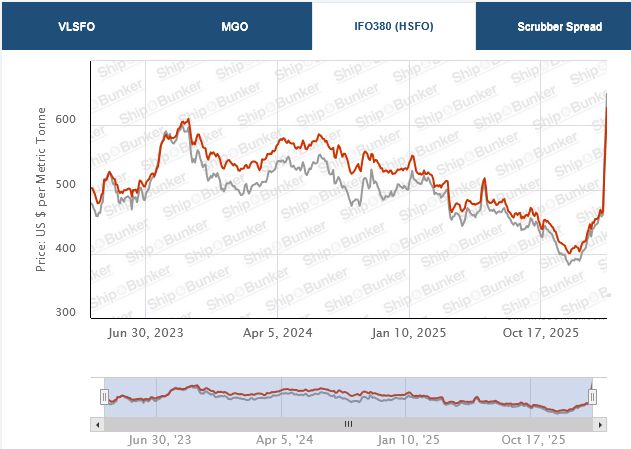
The sharp increase in maritime fuel prices has ceased to be merely a dispatch statistic and has become a real threat to the logistical framework in the Canary Islands. According to data analyzed by senior expert Philippe Janvier, the price of HFO bunker fuel, the most commonly used fuel by the global merchant fleet, has experienced a staggering 60% rise in just three months. This increase places the metric ton at $649, greatly exceeding the $403 recorded in mid-December 2025 and shattering the price ceilings of previous years.
Flora Energy issued a notice to shipping sector operators this Monday announcing that ‘we maintain local stock of marine lubricants approved by manufacturers in Las Palmas’ and ‘with inventory situated directly in one of the most important supply and service centers in the Atlantic, we can provide a fast and reliable supply to vessels calling at Las Palmas and nearby ports.’
The available products include lubricants of ‘high quality approved by leading engine manufacturers, ensuring optimal performance, protection, and compliance with OEM requirements’ through ‘Flora Energy’s maritime support network.’
This inflationary scenario coincides with a global route crisis that forces shipping companies to avoid the Suez Canal. The voyage between Singapore and Rotterdam has increased from the usual 26 days to about 36 days by diverting around the Cape of Good Hope. For the maritime sector in the Canary Islands, this presents a double-edged logistical challenge: on the one hand, the archipelago regains its strategic value as a refueling point on the South Atlantic route; on the other hand, the cost of navigating an additional ten days with fuel that is 60% more expensive escalates freight rates to unsustainable levels.
Las Palmas consolidates its position among the 20 most important supply ports in the world, appearing in the benchmark indexes of ‘Ship & Bunker’ alongside giants such as Singapore, Houston, or Rotterdam. However, being listed in this elite group in 2026 also means being exposed to the extreme volatility of an unbridled energy market. Efficiency in bunker operations at Canary ports is no longer just a competitive advantage, but the only way to mitigate the impact of prices that offer no respite to shipowners.
Janvier’s warning underscores that the increase in prices ‘at the pump’ is merely the tip of the iceberg of a much larger problem affecting the entire supply chain. With longer voyages and fuels priced like gold, the risk that this additional cost will eventually be passed on to the Canary consumer is imminent. The economy of the islands, dependent on maritime imports, watches with concern as bunker costs redefine the rules in an increasingly costly and complex Atlantic.







