




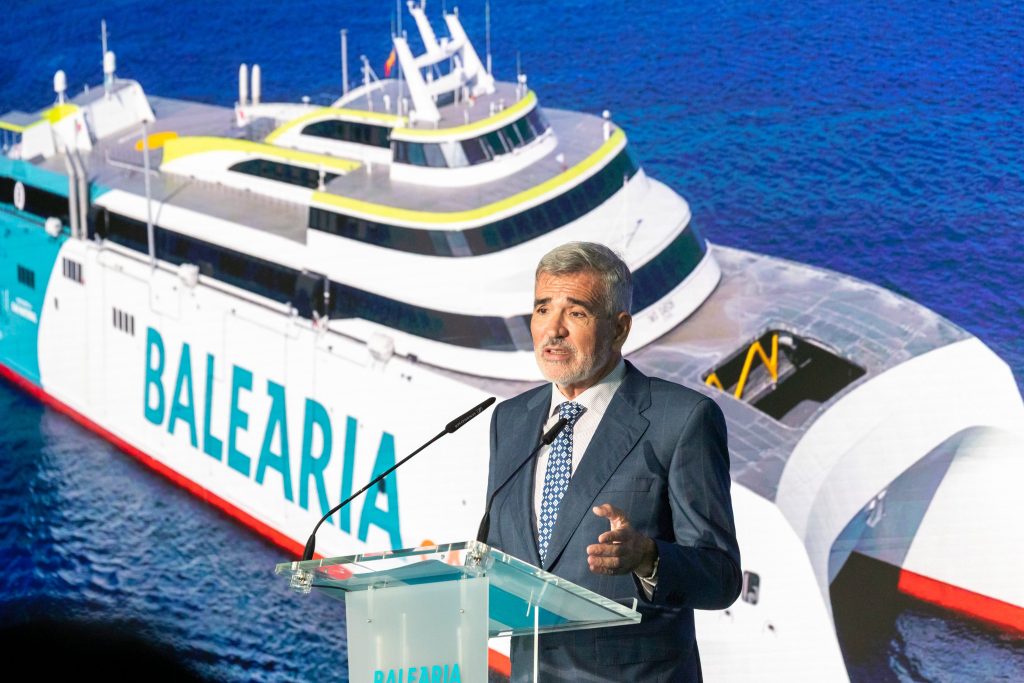
The maritime transport market in the Canary archipelago is facing a significant structural reconfiguration. Baleària Canarias has formalized the entry into service of its new high-speed vessel, the Mercedes Pinto, a state-of-the-art catamaran intended to operate the strategic triangle between Santa Cruz de Tenerife, Las Palmas, and the port of Morro Jable in Fuerteventura. The operation, which has required an outlay of 128 million euros on the part of the Denia-based firm, represents the company’s most aggressive move since absorbing the assets of Armas Trasmediterránea, consolidating a deployment aimed at challenging the historical hegemony of passenger and cargo transport in the Spanish outermost region. No commercial negotiation has been established with the firms mentioned for this news report.
Baleària’s strategy aims to capture a majority share in the rolling cargo and executive class passenger segments, two high-margin niches that demand reliability in scheduling and speed in transit. The corporation’s president, Adolfo Utor, has indicated that the knowledge accumulated during the last seven years of operations in the islands justifies the specialization of the fleet to respond to the economic asymmetries of each island. The expansion plan includes, in the short term, the arrival of the fast ferry Pepita Castellví to reinforce routes on the western axis and the pure cargo vessel Josefina de la Torre, whose mission will be to absorb the increase in imports and exports with the ports of the Iberian Peninsula.
The presentation event, which gathered over 400 representatives from the political, economic, and port sectors in Tenerife, received explicit support from the regional president, Fernando Clavijo. The launch of this unit brings the total number of operational vessels in the company’s Canary division to twelve. The business plan includes an additional investment of 45 million euros over the next three years, a budget allocation that will be dedicated exclusively to technological upgrades and modernization of the integrated units following recent corporate acquisitions.
Asset Optimization and Frequencies on the Eastern Axis
The incorporation of the Mercedes Pinto significantly modifies the transport capacity on inter-island maritime corridors. The shipping company has designed an operational scheme that will work in coordination with two other high-speed vessels: the Volcán de Taidía and the Volcán de Tagoro. This concentration of technical resources will enable the structuring of a network of six daily departures between the two Canary capitals, three connections between Las Palmas and Morro Jable, and two direct links between Fuerteventura and Tenerife. This last commercial line will allow for the journey to be made without the need for transshipments, setting the crossing time at just over 4 hours.







