




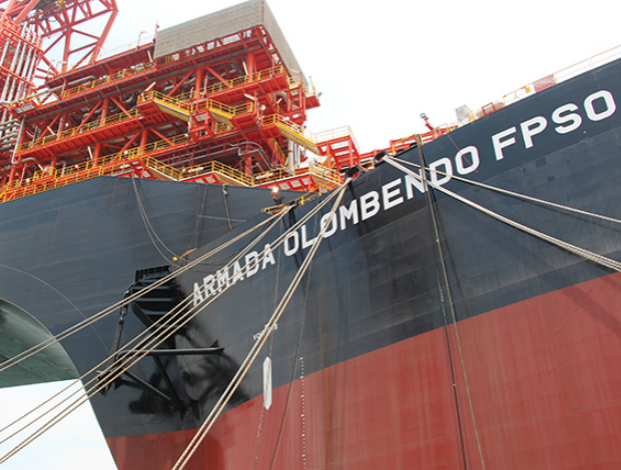
The maritime security ecosystem along the axis connecting the Gulf of Guinea with the Canary Islands has entered a phase of red alert during the first two months of 2026. According to consolidated data from Priavo Security reports published this Tuesday, the region is not only facing an unprecedented migration crisis, but has also been witness to direct attacks against high-value strategic assets. The focus of international concern revolves around two incidents that define the current threat: the attempted intrusion on an ENI floating production, storage, and offloading unit, the FPSO Armada Olombendo, in Angolan waters, and the violent kidnapping of the crew of the fishing vessel IB FISH 7 in Gabon. These events, combined with a migratory activity that has seen 2,181 individuals deactivated on the route towards the Canary Islands and African coasts, paint a picture of extreme risk for logistics and energy operators.
The attack on Armada Olombendo suggests that criminal gangs are testing the defenses of the oil industry, which could lead to attempts to kidnap specialized personnel or more significant sabotage if peripheral security protocols are not reinforced.
Cabinda
The incident involving the FPSO Armada Olombendo, located about 50 nautical miles off the west coast of Cabinda, highlights the audacity of local criminal groups. On February 5, 2026, an intruder, part of a group of five individuals aboard an 8-meter wooden boat, attempted to board the platform by climbing one of the mooring chains. Although the attacker was not visibly armed and fled upon detection, the event underscores the vulnerability of these critical oil infrastructures to opportunistic incursions. This pattern of ‘boarding by chain’ was repeated at other points in the Gulf of Guinea: on January 20, at the anchored vessel Lake Ontario in Luanda, an intruder armed with a knife managed to gain access to the foredeck, while in Takoradi (Ghana) on January 7, a tanker suffered damage to its scupper pipe protector and theft of equipment after a similar incursion by the anchor chain.
The escalation of violence peaked with the kidnapping of the IB FISH 7, a Gabon-flagged vessel (formerly known as FV Lian Peng Yu 828). On January 11, 2026, while operating 7 nautical miles from Ekwata, armed pirates boarded the vessel and kidnapped 9 crew members, of which five are Chinese nationals and four are Indonesians. The sophistication of the captors was evident in their monitoring of communications, revealing a logistics support network to refuel near Kribi (Cameroon) before transferring the hostages to Nigerian territory. This attack was not an isolated event; on the same day, a passenger vessel was assaulted by two speedboats on the route from Nigeria to Cameroon, resulting in an armed confrontation with Cameroonian troops who successfully rescued 18 passengers after one of the pirate boats capsized.
The record of thefts and sabotage in the region during January and February is completed with mass attacks on the artisanal and logistics fleet. On February 26, seven fishing boats off the coast of Ghana were shot at by men in a ‘black boat’ who stole outboard motors and generators, leaving 71 fishermen adrift. Previously, in Abidjan, the supply vessel Blue Mommy reported the theft of materials following a boarding on January 6. These incidents contribute to a statistic of insecurity intertwined with the humanitarian crisis in the north. During the two-month period, maritime surveillance had to manage the interception of 2,181 migrants. Of these, 1,210 were rescued or intercepted in Canarian waters (including dramatic cases such as the 143 migrants, with 72 minors, in La Gomera, or the 144 in El Hierro), while the remaining 971 were detected in operations in Gambia, Senegal, and Western Sahara, with unfortunately 33 confirmed fatalities during this period.
The data from Priavo Security for the start of 2026 confirms that security in the Atlantic cannot be analyzed in isolation. The weakness in controlling anchorages in Luanda or Abidjan and the impunity of armed attacks in Gabon and Ghana are directly related to the instability pushing migratory flows towards the Canary archipelago. The operational capacity of local marinas is being tested by a crime wave that, as in the case of the IB FISH 7, has the capacity for cross-border coordination, and a migratory pressure that, in January alone, mobilized groups of up to 782 people intercepted in a single operation in Gambia, representing nationalities as diverse as Mali, Guinea-Conakry, Senegal, and Burkina Faso.







