




The intersection between the reincarnation of Abengoa’s assets —now under the banner of Cox— and port logistics in the Central Atlantic has found a common link of a purely corporate nature. At the epicenter of this network is Alejandro Fernández Ruiz, an executive whose ability to be present on boards is redrawing the lines of influence in the Port of Las Palmas.
The sequence of dates reinforces the thesis of an operation in progress: In August 2024, Fernández Ruiz becomes vice president and attorney of Transvirgin and in October 2024 he joins the board of the parent company of Cox and assumes the presidency of the Nominations Committee. In January 2025 he secures representative power in Sepcan. This pattern of prior landings is classic in buy-and-build strategies. By placing a trusted man of the parent company at the helm of local companies, Cox ensures that, should complete integration occur, the assets align with the standards of the listed company.
As Cox, the utility led by Enrique Riquelme, consolidates its structure following its recent stock market debut, Fernández Ruiz’s presence acts as a strategic bridge between energy and port services. His rise within the parent company’s hierarchy is recent but significant: on October 15, 2024, he was appointed a director of Cox ABG Group SA, taking office just a week later, on October 22, as president of the Nominations and Remunerations Committee, the body that defines governance and incentives for the energy giant.
Buy-and-build
However, it is in the logistics dimension where the plot gains its greatest depth. Fernández Ruiz not only oversees the future of the former Abengoa; just two months before his entry into the board of Cox, on August 8, 2024, he consolidated his power in Transvirgin SL, a key piece in the port machinery, where he holds the offices of vice president, director, and joint attorney. This dual role places him in a privileged position to mediate the synergies between the energy demand of the infrastructure and the specialized transportation services.
The network extends even further across the Canary Islands. On January 20, 2025, Fernández Ruiz was appointed attorney of Canary Port Services (Sepcan), directly linking his management to the daily operations of the docks. This accumulation of positions —with 33 active roles currently— suggests a strategy of vertical control where the Port of Las Palmas is not just a mere stage, but the node where the interests of the ‘new Abengoa’ converge with logistics for hydrocarbons and Transvirgin services.
Anchors
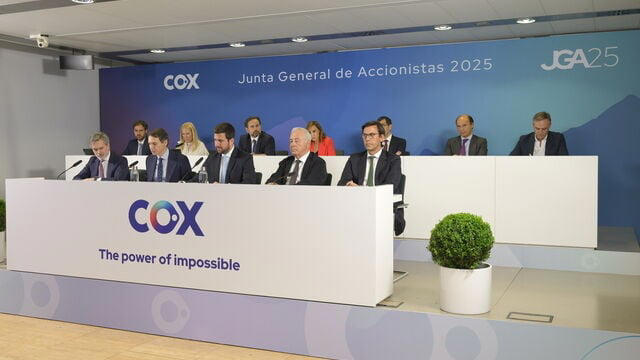
As Cox holds its first General Shareholders’ Meeting boasting an EBITDA of 183 million euros and net debt of only 62 million, the engineering of its board reveals a quieter ambition. With the backing of figures such as Dámaso Quintana and Larry Coben, the company seeks stability, but it is through executives like Fernández Ruiz —capable of transitioning from the real estate sector in Butarque to clean energy at Epsilon— that the group secures its anchors in strategic sectors.
In Las Palmas, this connection between Cox and Transvirgin under a single executive command poses a new paradigm of operational efficiency, but also a concentration of technical influence that will be closely monitored by market observers. Fernández Ruiz’s ability to manage appointment times —five high-level positions in just six months between 2024 and early 2025— underscores that, in the current economic cycle, real energy moves through the minutes of boards.
The corporate architecture surrounding Alejandro Fernández Ruiz suggests more than a mere accumulation of positions: it seems to be the deployment of a strategic advance in a setting where energy and port logistics are inseparable. In the language of the Financial Times, such movements often precede a consolidation of assets or a vertical integration that the market has yet to fully digest.
The hypothesis of the white label
Fernández Ruiz’s entry into the board of Cox ABG Group (the parent company of Enrique Riquelme’s empire) in October 2024, just months after taking control positions in Transvirgin SL and Canary Port Services (Sepcan), does not seem to be a mere coincidence of agenda. In the Port of Las Palmas, Transvirgin and Sepcan operate in a critical niche: waste management (Marpol) and technical-nautical services.
For a giant like Cox, which is seeking to position itself as a leader in water and energy after absorbing the remnants of Abengoa, controlling the ‘last mile’ of port services through transversal figures allows for two things: Quiet exploration with established local brands avoids the price inflation associated with the name of a listed company and reduces initial regulatory scrutiny. Fernández Ruiz, with his profile as a financial expert (a graduate from Comillas-E2) and his network of nearly 500 historical positions, acts as the ideal ‘facilitator’ to audit profitability from within these operators before a formal absorption by Cox.
The capital of Cox
Cox’s control is concentrated with an iron fist in a capital structure where Enrique Riquelme exercises absolute dominance, holding 59.59% of the shares with a market value of 591 million euros. This hard core is supported by Alberto Zardoya (12.92%) and strategic industrial partners such as Cunext (4.9%), forming a control shareholder structure that leaves little margin for institutional investors. Among the latter, minority positions from Andbank, the Brotherhood of Architects, and various asset management firms such as Quadriga or GVC Gaesco stand out as financial companions in a utility whose course and cash remain almost symbiotically linked to the vision of its founder.
In the cold balance of power at Cox, Amea Energy Investments appears as the fourth horseman of capital, occupying a discreet but strategic 3.45% of the company. With a valuation of around 34 million euros, this company represents the investment arm of capital from Africa and the Middle East (AME), providing Riquelme’s utility not only with financial backing but also the geopolitical validation necessary for its expansion into emerging markets. While Riquelme and Zardoya dictate the main melody, Amea acts as the silent accompaniment that ensures the connection of the former Abengoa with the investment flows from the Gulf, consolidating a shareholder structure where proximity to regional power is as valuable as capital itself.







