




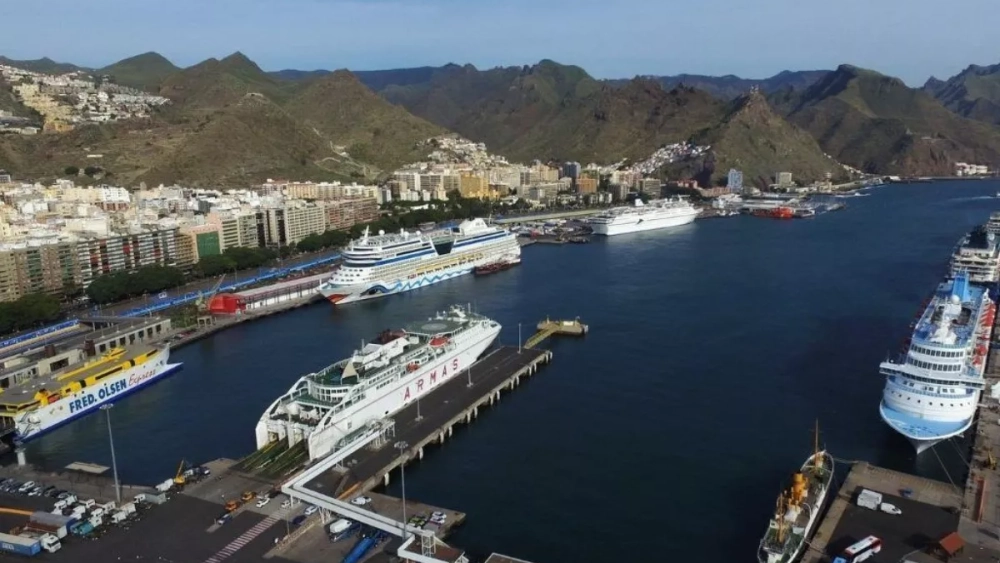
In what seems to be a desperate attempt to turn the Muelle de Enlace into the scene of a time loop, the Basque company Construcciones Dique del Este, S.A. has once again emerged burned from the courts. The Canary Islands justice system has issued a ruling regarding a debt of merely €1,216.41 corresponding to the activity fee for 59 days of the 2022 fiscal year. For the judges, the case had a touch of déjà vu, as the claim was ‘substantially identical’ to another that the same Chamber had dismissed just a month earlier, on April 10, 2025. A reminder that, in the port of Santa Cruz, some battles run aground even before setting sail, even though there are people in Granadilla managing port operations with a master’s degree in family affection to choke Tenerife’s growth.
The High Court of Justice of the Canary Islands (Contentious-Administrative Chamber, Section One), based in Santa Cruz de Tenerife, has been tasked with delivering this ruling. In a display of legal firmness, the court—composed of judges Pedro Hernández Cordobés, María del Pilar Alonso Sotorrío, and rapporteur José Juan Suay Rincón—dismissed the company’s appeal on the grounds that their arguments were a repetition of prior lawsuits and lacked temporal or geographical foundation, as the regulation applied was still in effect and the location of the plot in Zone IV was undisputed.
In the corridors of the High Court of Justice of the Canary Islands, the air smells of cold coffee and files that seem like photocopies. The protagonist of our bureaucratic comedy attempted to annul a settlement of the Activity Fee (T11) for the astronomical figure of €1,216.41. What is fascinating is not the amount, but that the court handled the matter with a legal yawn, pointing out that the claim was a ‘copy-paste’ of one they had already dismissed just a month before. They argued that, after ten years, the regulation was a ‘zombie’ legal provision. However, the rapporteur judge José Juan Suay Rincón pulled out the calendar to remind them that during the contested period (January and February 2022), the order was still a year away from reaching its tenth anniversary.
But the shipwreck did not end there. The lawyers insisted that it was ‘impossible to determine’ whether their 4,651 square meters of area were in Zone IV. The court, with almost spiritual patience, responded that Zone IV is the only one that exists in the Muelle de Enlace, so getting lost on the map was an unnecessary effort.
The climax of the absurd arrived during the evidentiary phase. After mobilizing the judicial machinery to carry out procedures, the company reached the final stage and, in a display of procedural amnesia, did not even mention these pieces of evidence in their conclusions. The outcome was inevitable: the appeal has been dismissed to preserve ‘legal security’ and coherence, leaving the plaintiff with the same debt and, as a bonus, a condemnation for costs.
The most surreal moment of this administrative drama arrived during the evidentiary phase. After mobilizing resources to carry out procedures, the company reached the stage of conclusions and, in a display of procedural amnesia, did not even mention these pieces of evidence. Given such a panorama, the Chamber not only dismissed the appeal to preserve ‘legal security’ and ‘coherence’, but also penalized the contractor’s insistence with the imposition of legal costs.
News written by Gara Vega H. Edited and verified by Pedro Marrero. Information cross-checked without institutional filters. This analysis has not been funded by official advertising nor conditioned by lobby interests.







