




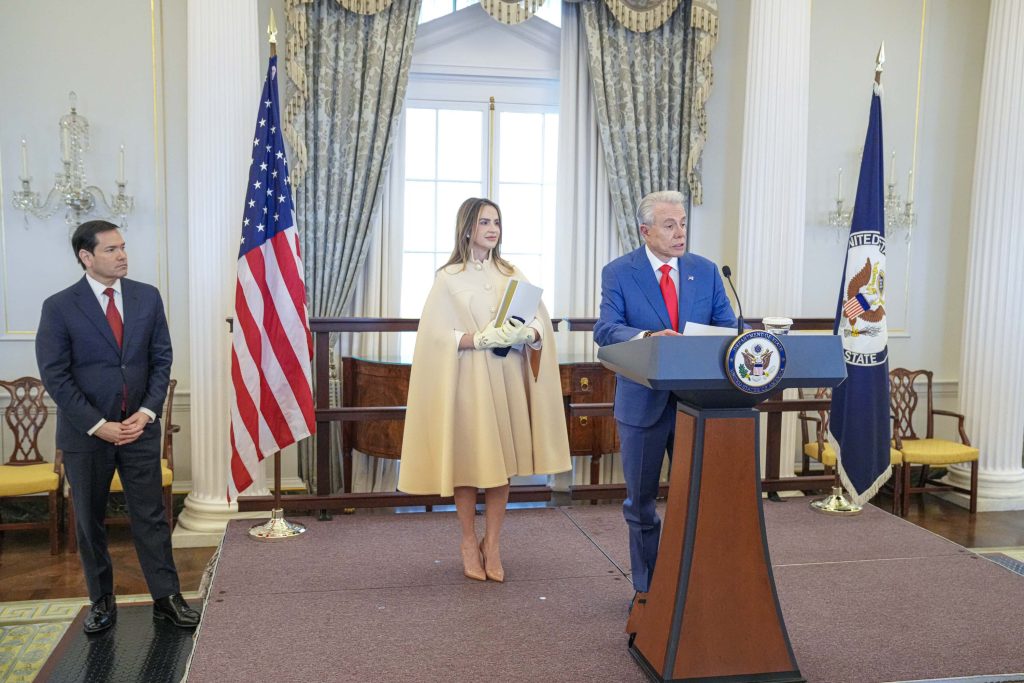
The arrival of Benjamín León Jr. at the U.S. embassy in Madrid is not a courtesy appointment; it is the landing of an asset manager on a clear mission. Once he advances his institutional agenda in Madrid, he will come to Tenerife, a destination that has transitioned from a holiday spot on maps of the U.S. State Department to becoming a national security priority. In fact, according to what Canarymaritime has learned, it is one of the first things that would be on his agenda once the logical meetings are executed following his assumption of office and the presentation of credentials this week in Madrid.
The Southern Shipyard: The Missing Piece for Rubio
The critical point of León Jr.’s visit, scheduled before June according to Canarymaritime, is named Granadilla. While port bureaucracy gets tangled in reports, Washington has a ‘great interest’. Its analysts see the future naval repair platform in southern Tenerife as the missing piece to secure the logistical control of the Central Atlantic. From the U.S. diplomatic environment, it is suggested that ‘the choice of Tenerife is not unconditional, but responds to an expectation of technical efficiency and procedural transparency that does not tolerate past bureaucratic asymmetries.’
It is not a matter of money; it is a matter of operability. With the African Lion maneuvers on the horizon, the U.S. Navy needs Tenerife to be its trusted workshop in 2027, as it will not be ready in time for 2026 due to the maneuvers taking place in May. The idea is that any vessel operating in West Africa can come in, repair, and leave without detouring to Rota or crossing the ocean. León Jr., a man who built an empire optimizing services in Florida, comes precisely to verify if the port is ready to be the steel that supports its logistics.
A Warning to the Administration
Diplomatic sources consulted by Canarymaritime have been clear: ‘Washington seeks to foster an institutional culture of growth’. The message for port staff and administration is a warning to navigators: ‘They must understand that they are part of the solution and not the obstacle. Either there is alignment with the value chain, or bureaucratic frictions will ultimately undermine the competitiveness of the offering.‘
Legal Certainty vs. the ‘Maze’
León Jr. would not come to ask for permission. He would bring a direct message of legal certainty. The U.S. knows that in the islands, projects often die of old age in drawers (such as that antenna of the U.S. Chamber of Commerce in Las Palmas that went bankrupt, for example). For the U.S. administration, Tenerife must function as a ‘fixed aircraft carrier’: efficient, fast, and above all, sound. The blood connection between León Jr. and Rubio is the lubricant for a negotiation that seeks to transform the Washington-Tenerife axis into a node of economic pragmatism. The time for photos is over; the time for real logistics begins.







