




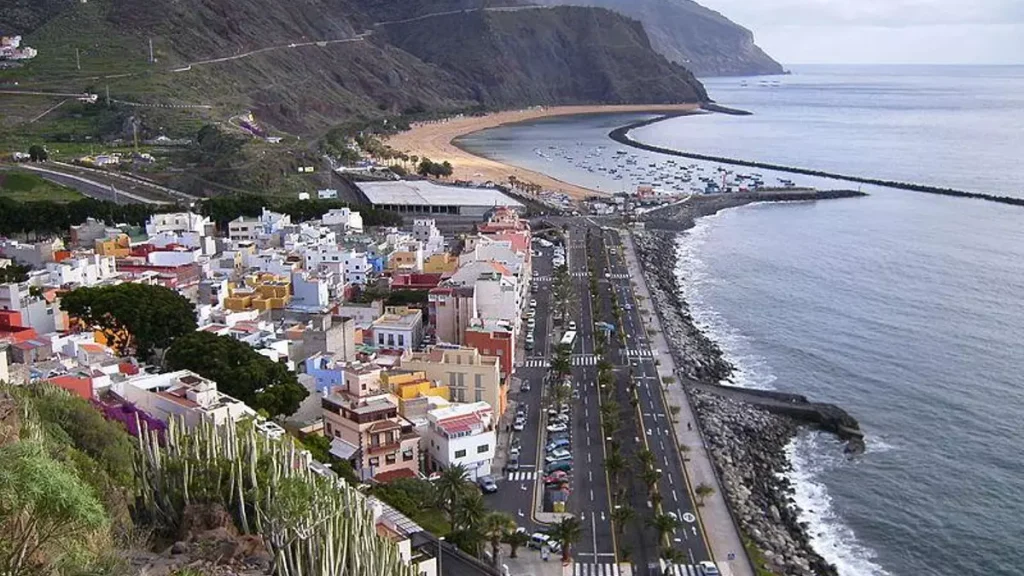
The Supreme Court confirmed this Wednesday that it has issued a key ruling that limits the ability of the real estate Group Bricansa, S.A.U. in its attempt to overturn the ruling that denied it compensation for the San Andrés marina project in Tenerife. The Administrative Litigation Chamber dismissed the appeal submitted by the developer, reaffirming its refusal to allow the introduction of new facts and documents into the extraordinary review process. At stake was a claim for lost profits, among others, amounting to 143 million euros.
According to Canarymaritime, the Supreme Court has described Bricansa’s line of argument as ‘confusing’, stating that this procedure cannot be used to reopen the dispute nor to introduce documentation, such as the discrepancy file by the President of the Ports of the State, outside the legal channels provided.
Process
The appellant, Pérez Labajos, blamed the Port Authority of Tenerife for sending the modification to the Environment department knowing that it would “necessarily” not pass the Environmental Impact Study, which constituted “an announced failure.” Regarding the breakwater, he blames the state agency for executing it through an emergency route, thereby bypassing the environmental report, despite the fact that flooding in San Andrés has been cyclical for decades. The concessionaire always maintained that the procedure was “very irregular, with manipulated documentation,” a claim that now seems to be supported by the Supreme Court, which has ordered a review of the ruling for these reasons.
The legal conflict centers on the nature of the review appeal, which is directed against judgments that are already final. Bricansa sought to open a procedure to add facts of ‘extraordinary relevance’ alleging the existence of fraudulent machinations. However, the court, under the lead of Judge Pablo Lucas Murillo de la Cueva, emphasized that the rules governing these appeals must be interpreted strictly.
Theories
The Chamber argues that the developer improperly attempted to add a new ground for review — the emergence of decisive documents — to the initial ground of fraudulent machination, which would alter the terms in which the original claim was made.
The ruling highlights that the real estate company’s approach seemed to seek a response to the arguments already presented by the State Attorney and the Public Prosecutor’s Office, who requested confirmation of the initial denial. The Supreme Court has categorized Bricansa’s line of argument as ‘confusing’, indicating that this procedure cannot be used to reopen the litigation debate or to introduce documentation, such as the discrepancy file by the President of the Ports of the State, outside the legal channels provided.
As a result of the dismissal, the Supreme Court has imposed on Grupo Inmobiliario Bricansa the payment of legal costs. The Chamber has set the maximum amount that the State Attorney could claim for this concept at 300 euros. With this resolution, dated January 15, 2026, the High Court maintains strict control over the procedure reviewing the actions of the Superior Court of Justice of the Canary Islands regarding the failed Tenerife port project.
Lost Profits
In March 2025, it became known that the TSJC previously rejected the appeal filed by the entity that sought to build a marina at San Andrés and the Maritime Club, in which it claimed 143 million euros from the Port Authority for the obstacles faced in executing the work.
The owner of Bricansa, José Ana Pérez Labajos, requested compensation from the courts for the damages resulting from the occupation of the concession by the current containment breakwater in front of the village, a sum quantified by four appraisal companies. The civil procedure law allows for the review of final judgments when decisive documents appear that were not considered, the existence of false evidence and statements, or if the lawsuit was won through bribery, violence, or fraudulent machination.
The concession dates back to 2002, was modified ex officio two years later, and the facilities were moved from the village front to the Fishing Dock. Although it was stated that this was not a substantial change, an Environmental Impact Study was requested. The result was negative in that posidonia meadows, special bird protection areas, and historically and archaeologically significant zones were affected, making it impossible, according to the Port Authority, to carry out the concession review, and the works were never executed.
The TSJC, in its 2023 ruling, concludes that the concession is currently suspended, not resolved, and that the existence of a negative report does not imply the nullity of the breakwater works since the original project and the current one are different. Therefore, the court concluded that the conditions to establish the existence of illegal occupation or deprivation of the concession underlying the denied compensation claim were not met.
News written by Raquel Molina. Edited and verified by Pedro Marrero. Information cross-checked without institutional filters. This analysis has not been funded by official advertising nor conditioned by lobby interests.







