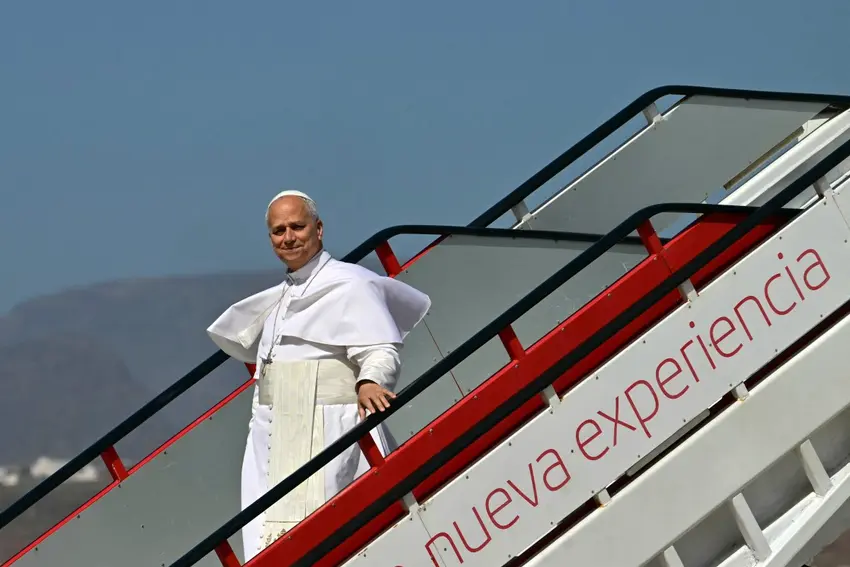
The ports of Arguineguín and Santa Cruz de Tenerife are protagonists of the presence of Pope León XIV, who arrived this Thursday in the Canary Islands on a low-cost airline flight to meet with survivors of the Atlantic migratory route, one of the most dangerous access routes to Europe in the world. The trip takes on a profound symbolic dimension by fulfilling the desire of his predecessor, Francisco, who passed away a year ago without being able to execute this trip. The presence of the Pontiff coincides with the impact of the figures for 2024, a record year in which more than 46,000 people reached the island’s shores in precarious vessels fleeing conflicts and poverty from the African continent.
The Arguineguín dock, in Gran Canaria, has become the epicenter of the most moving events of the papal agenda. In this port space, León XIV laid a floral offering in memory of the victims of the ocean, estimated by the International Organization for Migration (IOM) at nearly 1,200 deceased or missing just during the last year. This liturgical and civil gesture seeks to transform the international perception of a port that in 2020 was dubbed the ‘dock of shame,’ when the collapse of the reception system forced more than 3,000 migrants to spend the night outdoors.
Emergency teams
Humanitarian and religious groups in the archipelago have highlighted the significance of the presence of the head of the Catholic Church at a time of intense humanitarian pressure. Mohamed Amjahdi, deputy delegate of the Spanish Islamic Commission, who arrived in the islands from Morocco at the age of 17, emphasizes the absence of distinctions in rescue tasks, stating that Catholic entities provide assistance to all individuals regardless of their origin or belief.
The daily reality of rescue operations along the coast was evident in the testimony of first response teams. José Antonio Rodríguez Verona, regional head of the Red Cross, described the duality of experiences in the port facilities, where the satisfaction of successful rescues coexists with the frustration at the arrival of deceased individuals. The bishop of the Diocese of the Canary Islands, José Mazuelos, recalled that Pope Francisco himself left in writing the dual objective of this mission: to support the Canary community in its humanitarian response and to shed public light on the migratory drama.
Contrast with control policies in the European environment
The Pontiff’s visit introduces an element of political debate within the framework of decisions made by state administrations. During his address to the Spanish Parliament last Monday, León XIV explicitly called for the opening of safe and legal pathways for immigration, demanding dignified reception conditions and real options for social integration. The Vatican’s positioning coincides temporally with the regularization measures promoted by Pedro Sánchez’s Government for around 500,000 migrants in irregular situations, a direction contrary to the restrictions imposed by other countries in the European Union.