




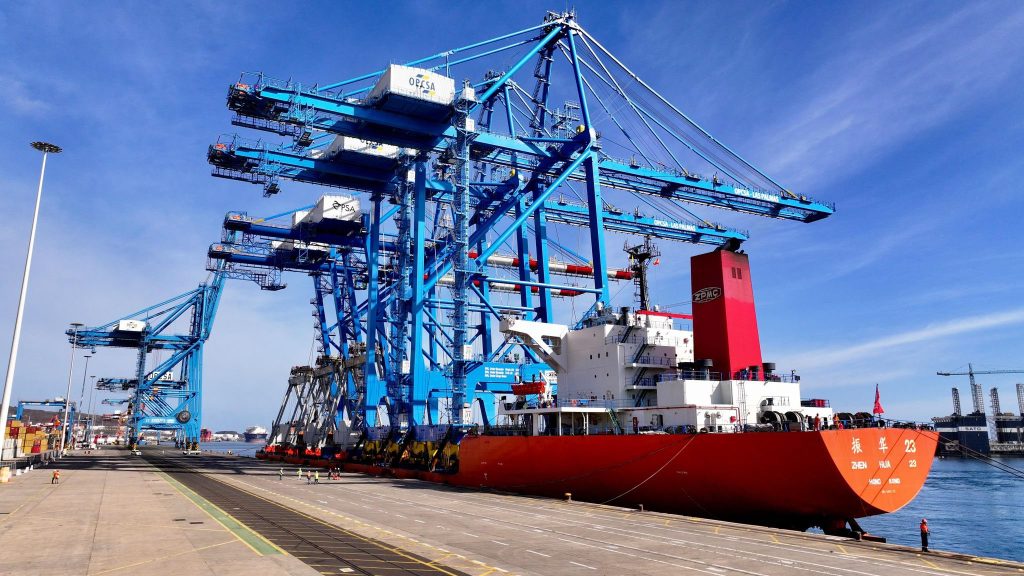
The Port of La Luz and Las Palmas is about to make a giant leap, but the landing is not going to be as smooth as expected in the offices. The OPCSA terminal (under the TIL/MSC umbrella) is already hosting its new units: colossal Malaccamax cranes from ZPMC and eight yard cranes that promise to elevate container movements above one million TEUs. A 50 million euro investment that, on paper, looks promising. However, the celebration has been dampened by a report that has hit like a bomb from the Capitol in Washington. Here you can read the European Parliament report on this subject.
The figures reported by Rafael Navarro, operations director of the TIL subsidiary in Las Palmas, Opcsa, are cause for celebration: the MSC terminal closed 2025 with over 1.1 million TEUs. The problem for Las Palmas is another: the stevedoring right wingers continue to offer salaries of 8,800 euros net per month, and these salaries are lower and more rapid in emerging ports.
However, while ships begin to look again at the Suez Canal to save 15 days of navigation, there is no panic at Opcsa. The directive is clear: MSC’s commitment to Gran Canaria is ‘decided’ and ‘top-notch’. Navarro is already setting the bar at 1.3 million containers for 2026, the technical limit of the terminal. The plan is to compensate for the loss of ships returning to Suez with new routes to Latin America and Central America, thus safeguarding the strategic role of La Luz.
While they celebrate modernization here, a joint investigation by the U.S. National Security and Competition Committees regarding China has put ZPMC in the crosshairs. And this is not a trivial critique. The report details a ‘dangerous dependency’ on the technology of this Chinese state giant, revealing findings that seem straight out of a Tom Clancy novel: cellular modems installed in cranes that no one requested, which are not included in the contracts and, according to U.S. experts, are used to collect usage data and bypass local firewalls.
At the port of Las Palmas, where ZPMC cranes are the usual landscape, the debate is no longer just about whether we are faster at loading a 24,000 TEU vessel. The question that is starting to circulate in port gossip is whether these new assets are, in fact, ‘Trojan horses’ with a direct connection to Shanghai. The U.S. report is unequivocal: the proximity of ZPMC’s factories to the shipyards where Beijing builds its most advanced warships is not a coincidence, but part of a strategy to control the world’s logistics nodes.
Despite terminals like Las Palmas trying to mitigate risks by using European software (such as from ABB or Siemens), the U.S. Congress has discovered that many of those Western components are sent to China for ZPMC to install there, remaining under Chinese custody for months before crossing the ocean. This opens a backdoor to security that, in the event of a geopolitical conflict — with Taiwan always at the center of the board — could allow Beijing to paralyze the supply chain with a single click.







