




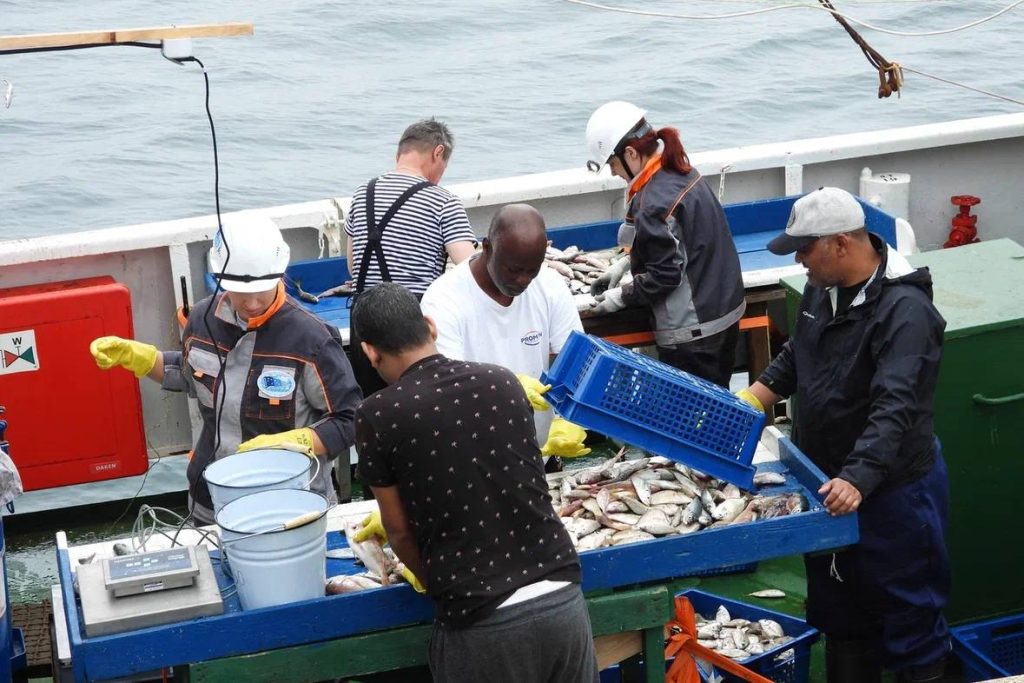
On February 6, 2026, the Russian government issued a statement. Headline: ‘The Great African Expedition has concluded: Russia is expanding its fishing industry in Africa.’ The literal text includes: ‘The first practical results have already been achieved.’ To add that the objective is to ‘expand the geography of Russian scientific research’ in the Mid-Atlantic. Here is the official Russian statement from the past weekend while in Las Palmas the employers’ association attacked the press for disseminating that Russian hydrocarbon derivatives are being used in the supply of vessels in the Canary Islands.
Thus, in the framework of developing cooperation with the Kingdom of Morocco, Russian catches in its Atlantic zone could increase from 60 to 90-100 thousand tons per year, mainly due to pelagic fish species: mackerel and jack mackerel. The expedition was a strategically important event to expand the geography of Russian scientific research. It was conducted in collaboration with scientists from coastal countries, and the information collected will be used to organize fishing operations with our African partners.’ This is signed in the official note by Ilya Shestakov, Director of the Federal Agency for Fishery.
In the statement about the so-called ‘Great African Expedition,’ distinguished by Moscow as the ‘first large-scale Russian fishing research on the coasts of Africa in decades, has successfully concluded’, it adds that ‘the work began in 2024 and was performed by two research vessels, the Atlantis and the Atlantiro, in the exclusive economic zones of six coastal states: Morocco, Mauritania, Guinea-Bissau, the Republic of Guinea, Sierra Leone, and Mozambique. The main objective of the expedition was to assess the state of aquatic bioresources in remote areas of the world’s oceans.’
As noted by Deputy Prime Minister Dmitri Patrushev, ‘the data obtained are of practical importance for ensuring sustainable, efficient, and environmentally friendly fishing.’ He emphasized that this large-scale research ‘is the first in modern Russian history and confirms its position as a leading maritime power‘, adds the Putin government.
During the expedition, scientific ties with African institutions were also reestablished. A bilateral cooperation agreement on fishing research was signed with the Republic of Mozambique. Furthermore, Sierra Leone expressed its willingness to grant the Russian side a catch quota of 40,000 tons of aquatic bioresources and access to its waters for 20 vessels. ‘The great African expedition opened new perspectives for the Russian fishing fleet, laying the foundations for joint enterprises with coastal countries, strengthening Russia’s position in Africa and opening new markets. The decision to carry out the expedition was made following the Russia-Africa Summit of 2023, and the project obtained federal status thanks to the support of the Russian government.’
‘The expedition was a strategically important event to expand the geography of Russian scientific research. It was conducted in collaboration with scientists from coastal countries, and the information collected will be used to organize fishing operations with our African partners,’ stated Ilya Shestakov, Director of the Federal Agency for Fishery.
During the expedition, scientific ties with African institutions were also reestablished. A bilateral cooperation agreement on fishing research was signed with the Republic of Mozambique. Furthermore, Sierra Leone expressed its willingness to grant the Russian side a catch quota of 40,000 tons of aquatic bioresources and access to its waters for 20 vessels.
‘The expedition was a strategically important event to expand the geography of Russian scientific research. It was conducted in collaboration with scientists from coastal countries, and the information collected will be used to organize fishing operations with our African partners,’ stated Ilya Shestakov, Director of the Federal Agency for Fishery.







