




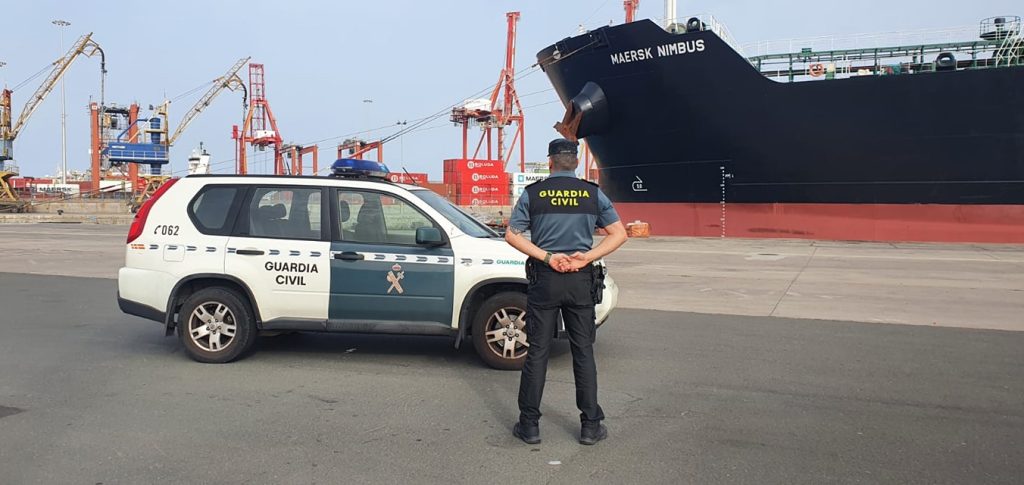
In the complex landscape of fuel trade in the Atlantic, where profit margins are measured in cents and taxes in millions, **precision is everything**. But **while Petrocan’s terminals (a subsidiary of Cepsa, now Moeve) at the Port of La Luz operated with the confidence of an untouchable giant**, a specialized team from the Civil Guard, under the mandate of the Las Palmas Prosecutor’s Office, wove a surveillance network that has revealed one of the most alleged systematic tax frauds in the Spanish energy sector.
The Device: Surveillance at ‘Kilometer Zero’
The investigation, whose keys have emerged with a level of detail worthy of a customs intelligence manual, focused in July 2021 on the exit from the Gran Canaria port facility. The agents were not looking for a random administrative error; **they were looking for the ‘DO Industrial’, the commercial name of the product leaving Cepsa’s tanks**. The protocol was militarily rigid: every tanker truck declaring to transport this diesel was intercepted at the tax inspection point, in front of the Plaza de Belén María.
What followed was not a mere document inspection, but **a “white glove” surveillance**. The investigators discreetly tracked the tanker truck on the island’s roads until its final destination. Only at the moment of unloading did the agents identify themselves, halting the flow of fuel under the watchful eyes of drivers and recipients.
The Bottle Test: Three Liters and a Lead Seal
To ensure the evidence was indisputable before a court, **the Civil Guard devised an almost surgical extraction procedure**. Once the unloading began, the driver was instructed to stop exactly halfway through the process. It was then that three liters of fuel were extracted, distributed in three one-liter glass bottles.
Each bottle was sealed with **labeled tape from the Civil Guard, and to avoid any shadow of doubt about its integrity, secured with a lead seal bearing the Corps’ emblem**. The entire process—from the opening of the valve to labeling—was recorded in high-definition video. The nine samples collected from nine different tanks were sent to the SGS laboratory, a global leader in inspection and analysis. The **verdict was unanimous and devastating: what Cepsa declared as fuel oil was, in fact, gas oil**.
The Arbitration of 7.7 Million
The difference between both products is not only chemical but also tectonically fiscal. Fuel oil, a heavy, dense residue, enjoys a minimal tax intended for large ships and power plants. Gas oil, on the other hand, bears a significantly higher tax burden. By declaring one for the other, investigators estimate that Cepsa evaded payment of €7,773,298.38 between 2016 and 2021.
The Tip of the Iceberg and the Shadow Over the Administration
This police operation has not only targeted two executives of Petrocan. The investigation has escalated to the upper echelons of the Canary Islands Tax Agency, where **the current deputy director of Import Taxes and the deputy director of Inspection are under scrutiny for their alleged inaction in response to warning signs**.
This ‘Cepsa case’ serves as a reminder that physical surveillance—the boot on the ground and the lead seal—remains the **last barrier against creative tax engineering at the borders of the European Union**. The tip of the iceberg, as the investigators themselves define it, could now force a complete restructuring of hydrocarbon oversight in these strategic Canary Islands ports.
This news has been produced exclusively with open intelligence sources and the support of our subscribers. At CanaryMaritime, we understand that holding power accountable requires not receiving a single euro from it.







