




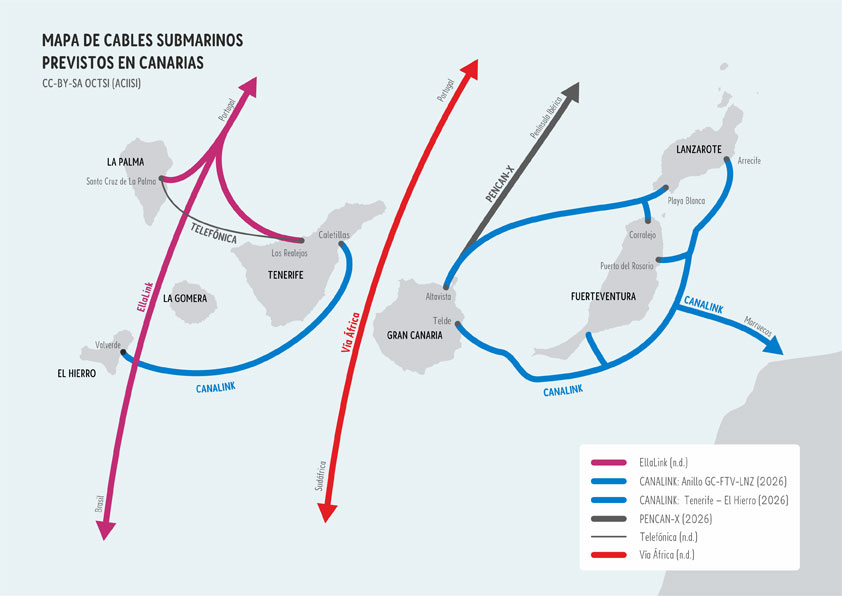
The Canary Islands, historically seen as an archipelago distant from major information flows, are undergoing a silent metamorphosis beneath the seabed. What was a precarious and vulnerable inter-island network decades ago has evolved into a high-capacity fiber optic framework that positions the archipelago as a first-order strategic node in the Atlantic. The recent wave of projects, driven by both tech giants and regional operators, has established the islands as an essential stopover between Europe, Africa, and America.
The Web Beneath the Sea
The telecommunications map in the Canary Islands has transformed from a straight line into a safety ring. The inter-island cables of Telefónica, deployed over decades, have been reinforced by operators like Canalink. This ring configuration is not a minor technical detail; it ensures that the breakage of a cable does not leave an island disconnected from the rest of the world. Since the Transcan 2 of 1990 to the recent connections of Canalink, the archipelago has woven a mesh that connects from Tenerife and Gran Canaria to the most remote points, such as La Palma or El Hierro.
However, the electrical infrastructure also plays a curious role. Although the new connections by Red Eléctrica between Fuerteventura and Lanzarote or Tenerife and La Gomera incorporate fiber optic, this remains outside public utilities, operating in a sort of technical reserve that underscores the robustness of the current design.
Canary Islands: A Tricontinental Digital Bridge
The qualitative leap comes with the external connection. The islands no longer depend solely on the old links with the peninsula. The PENCAN 7 and 8 cables, modernized with 100G technology, are no longer the only protagonists. The emergence of systems such as ACE (Africa Coast to Europe), WACS (West African Cable System), and, above all, the ambitious 2Africa system has changed the game rules.
The participation of consortia involving companies like Vodafone, Orange, and Canalink has allowed Tenerife and Gran Canaria to integrate into the longest cable system in the world, covering over 45,000 kilometers. This is not just an engineering milestone; it is a bet to turn the Canary Islands into a data node that connects the emerging digital markets of Africa with European technological power.
The Immediate Future: An Expanding Map
The roadmap for the coming months is aggressive. The Ministry for Digital Transformation and the European Commission have injected millions of euros to seal the last gaps in the network. Projects such as the connection of Tenerife with La Palma through EllaLink or the ambitious Canalink network for Gran Canaria, Lanzarote, and Fuerteventura, planned for 2026, will consolidate an infrastructure that aims for total redundancy.
This is not just about connecting islands. The deployment of the Vía África system, announced in May 2026, is the final piece of this puzzle. By linking the United Kingdom with South Africa via the Canary Islands, operators affirm that the archipelago is not a terminal destination but a critical crossing point in global data traffic. The replacement of the veteran PENCAN 7 with the new PENCAN-X is the ultimate proof: the installed capacity must grow at the pace demanded by demand.
The Geopolitics of Data in the Atlantic
Meanwhile, the Atlantic market is experiencing a tense calm. According to the Submarine Telecoms Forum, the route has risen from twelve systems in 2017 to nineteen in 2023. The demand for capacity, driven by the footprint of hyperscalers like Google, Microsoft, and Meta, has transformed the Atlantic seabed into a critical asset. The total capacity now exceeds 2,750 Tbps, a figure that just five years ago would have seemed science fiction.
Projects such as Google’s Nuvem cable or Meta’s Anjana demonstrate that major tech companies are no longer just purchasing capacity but are also building their own physical infrastructure. In this landscape, the Canary Islands have managed to position themselves. Connectivity is no longer a matter of convenience but of regional competitiveness.
The archipelago has ceased to be an isolated area and has evolved into a digital hub. The recent completion of the link with Cape Verde and the extension of Google’s Equiano cable towards Saint Helena indicate that the Atlantic periphery is disappearing. Today, the Canary Islands are the crossroads where European fiber, African needs, and American power converge. For a region that has historically struggled with its remoteness, the laying of these cables is not just an underwater engineering feat; it is, in essence, the tool that is eliminating its distance from the future. The digital sovereignty of the islands is no longer measured in kilometers, but in terabits per second.







