




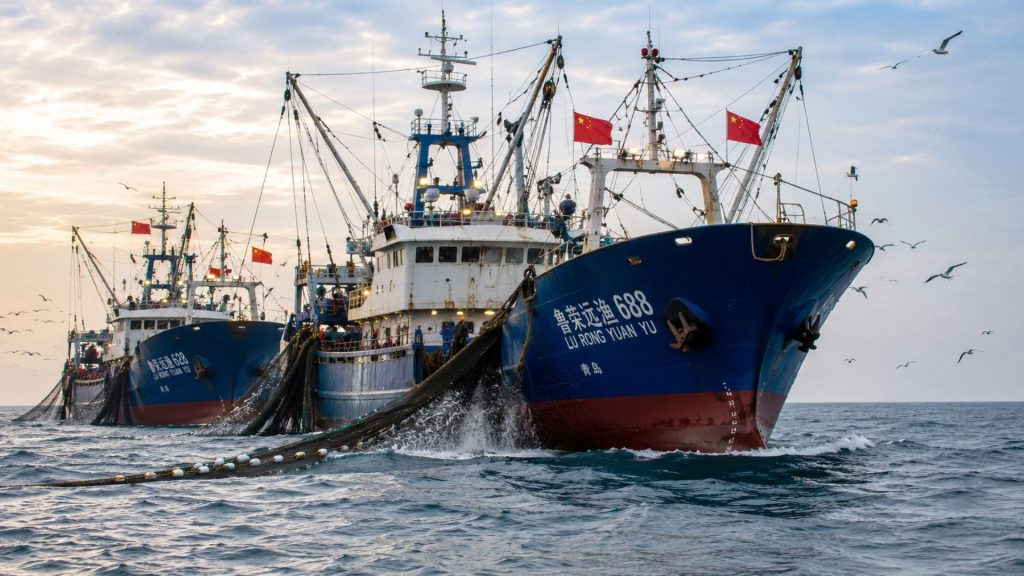
Data comes from Environmental Justice Foundation. The map of migratory dynamics in the Central Atlantic has entered a phase of maximum structural alert, directly conditioned by the ecological and economic degradation of West African fishing grounds. The maritime route connecting the coast of Senegal with the Canary Islands archipelago is experiencing an unprecedented increase in human flows, driven by the definitive collapse of the subsaharan artisanal fishing sector. This phenomenon is a response to the massive and uninterrupted activity of foreign industrial fleets, predominantly financed by Chinese capital, which have transformed the region’s waters into the epicenter of over 40% of the global illegal, unreported, and unregulated (IUU) fishing.
The opacity in the governance of joint venture companies operating in the region complicates the enforcement of international sanctions and the traceability of illegal catches. Investigations by the Coalition for Financial Transparency show that 43.7% of vessels licensed in Senegalese waters belong to corporate structures controlled by foreign parent companies, mainly based in Chinese industrial corporations.
These companies use flags of convenience, fraudulently alter their identification records, and carry out prohibited cargo transshipments in international waters to mix legal and illegal catches before distributing them in global wholesale markets.
The implications of this large-scale exploitation model transcend the environmental level to become the main driver of demographic destabilization on the African Atlantic coast. The forced conversion of a highly qualified fishing workforce into irregular migrants generates a drain of human capital that mortgages the autonomous development prospects of the sub-Saharan coastal regions.
As long as African port terminals suffer an economic performance decline due to the loss of control over their sovereign resources, the networks of human trafficking will maintain a constant supply of unemployed labor willing to undertake the crossing to the Canary Islands as the only survival alternative.
Pressure
The extractive pressure exerted by these factory ships generates estimated annual losses of 300 million US dollars to Senegal’s economy, systematically destroying the social and labor fabric that supports over 1.3 million people. The diversion of marine resources to international markets not only erodes the gross domestic product of coastal nations but also disrupts the protein supply for local populations. Fish represents the fundamental basis of food security among the lower-income strata of the country, and the current scarcity has driven up prices in domestic markets, spreading malnutrition and undermining social peace in historical coastal districts.
Environmental audit reports from the Environmental Justice Foundation confirm the severity of the biological crisis by certifying that 57% of the assessed fish populations in Senegalese waters are in a state of definitive collapse. High-protein and commercially valuable species, such as sardines and mackerel, have disappeared from artisanal exclusion zones due to the nighttime advance of bottom trawlers. These vessels operate by literally scraping the seabed, destroying breeding habitats and capturing tons of non-commercial species that are discarded or turned into fishmeal in processing plants controlled by foreign capital.
Critical Increase in Migratory Pressure
The operational asymmetry at sea has left the communities of Rufisque, Joal-Fadiouth, and Saint-Louis in a state of absolute economic vulnerability. Traditional fishermen are forced to extend their offshore sailing days for weeks, incurring unsustainable fuel costs and resorting to informal credit networks to keep vessels operational, which return to port practically empty. Faced with the material impossibility of competing with the detection and capture technologies of large industrial ships, thousands of maritime workers opt to liquidate their operational assets and use their large wooden canoes for long-distance human transportation to Spanish territory.
The geopolitical dimension of this migratory flow directly affects the management of the European Union’s external borders and has forced a reconfiguration of maritime diplomacy on the southern flank of the Canary Islands. The rupture of the fishing collaboration agreement between Brussels and Dakar, motivated by the Senegalese state’s deficiencies in supervising territorial waters and controlling illegal fishing, accelerated the regulatory vacuum and the lack of protection of the fishing grounds. This institutional paralysis granted a free hand to the expansion of Asian fleets, overwhelming the reception systems on the islands and forcing the Spanish Government to intervene directly through emergency bilateral negotiations.
The regulatory framework for trade and security exchanges has narrowed with the signing of a strategic memorandum of understanding between Madrid and the administration of President Bassirou Diomaye Faye. The binational agreement establishes the immediate deployment of high-resolution technological resources, including automated satellite tracking systems, mandatory vessel identification devices, and the formation of joint inspection teams at landing ports. These measures aim to equip Senegal’s customs authorities with the necessary operational capacity to oversee the movements of foreign fleets, although the lack of patrol boats and interception resources at sea hinders the effectiveness of control missions.







