




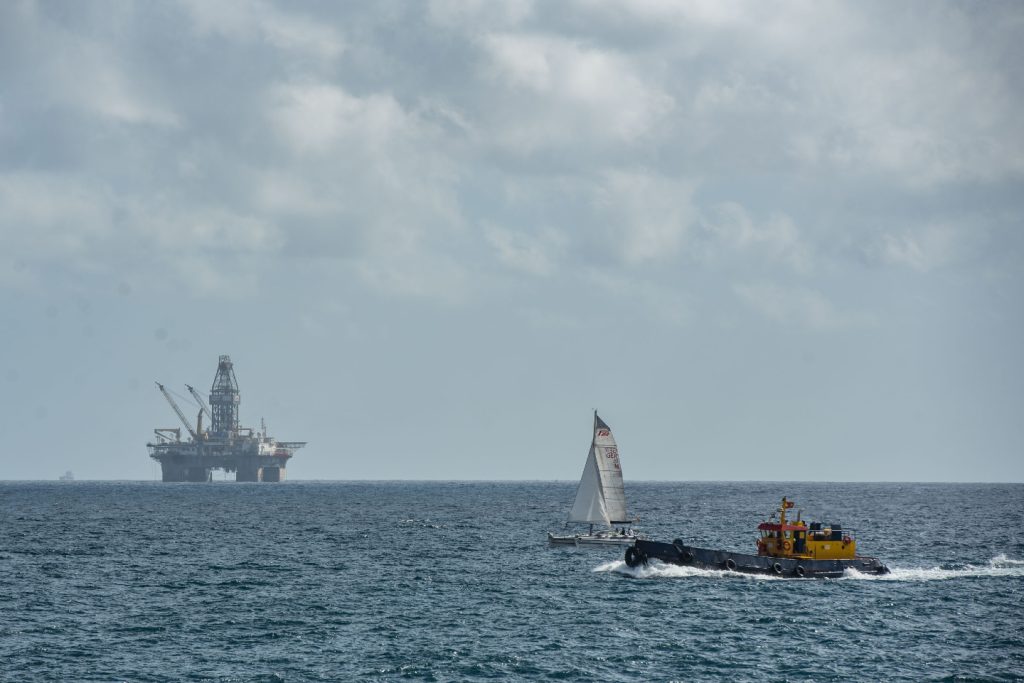
Few paradoxes are as revealing as the balance sheet of the province of Las Palmas regarding the business that comes from the sea. While the institutional discourse celebrates the blue economy as the structural pillar of the region —with a consolidated production in the province of Las Palmas of 2,500.4 million euros— a cursory audit of the balances of Unión Eléctrica de Canarias (Unelco) and Dinosol Supermarkets reveals a figure that questions the metric of diversified growth. Only these two entities generated 3,334.4 million euros in the last fiscal year, exceeding the production of the entire maritime-port sector in the province by 33% and creating a gap favoring these corporations of 834 million euros.
Blue Doctrine
This is relevant due to the report presented in Las Palmas by the president of Gran Canaria, Antonio Morales (NC), titled ‘Report on the Blue Economy in Gran Canaria’ prepared by the Economic Promotion Society of Gran Canaria (SPEGC), which analyzes the contribution of the marine-maritime sectors of the island’s economy and was presented this Wednesday by the president of the Cabildo, Antonio Morales.
The document, based on the latest available data from 2022, indicates that the total generated by the blue economy in the Canary Islands represents 7.18% of the regional GDP, and of this, 3.87% is attributable solely to Gran Canaria. Representing 54% of the total, Gran Canaria is well ahead of the other islands, followed by Tenerife (19%), Lanzarote (13%), La Palma (8%), Fuerteventura (4%), and the rest (2%). Additionally, the total output of the blue economy in Gran Canaria (1,901.3 million euros) against an island GDP of 18,786.4 million implies a direct weight of 10.12%.
From a purely financial perspective, we are not facing a calculation error, but rather a hyper-concentration of strategic assets. Endesa (Enel) operates with a recorded asset base of 1,649.2 million euros, leveraged in a captive market that allows it a sales efficiency of 1,868.4 million. Meanwhile, Dinosol, the giant of Canary retail, manages assets worth 916.5 million to sustain a revenue of 1,465.9 million. The sum of their balances reaches consolidated assets of 2,565.8 million euros, a figure that already exceeds the total valuation of the blue economy of the province, situated at 2,500.4 million.
Comparison and Key Points
The comparison among islands underscores this asymmetry within the province itself. The SPEGC report grants Gran Canaria maritime leadership with 1,901.3 million euros, representing 54% of the regional total, while Lanzarote and Fuerteventura contribute 457.8 and 141.3 million respectively, completing 71% of the regional weight held by the province of Las Palmas. However, the combined sales volume of the two aforementioned giants accounts for almost 95% of the production of the blue economy of the entire Canary archipelago, amounting to 3,521.8 million euros.
This scenario raises a critical question for investors regarding whether the blue economy is the real engine or a satellite of large centers of fixed costs. The resulting ratio is devastating: only two companies possess more assets than the entire productive valuation of the provincial maritime sector. While the marine sector is the main generator of net added value and specialization, the flow of capital in Las Palmas remains dominated by the management of basic resources, demonstrating how such a massive infrastructure of assets in just two firms can overshadow the performance of an entire ocean.
Clarity
The reading is clear: the province of Las Palmas has managed to transform its geography into a strategic financial asset. With a contribution to the regional GDP that already exceeds 7% in overall terms of the blue economy, the sea-based business model is shaping up as a real alternative to the dependency on the pure services sector. The integration of energy projects such as Salto de Chira and biotechnological development suggests that the ceiling of this Atlantic hub is still far from being reached, consolidating Las Palmas as the territory with the greatest projection of economic sovereignty in the outermost regions of Europe.
News written by Pedro Marrero from Tenerife. Edited and verified by Gara Vega. Cross-checked information without institutional filters. This analysis has not been funded by official advertising nor conditioned by lobby interests.







