




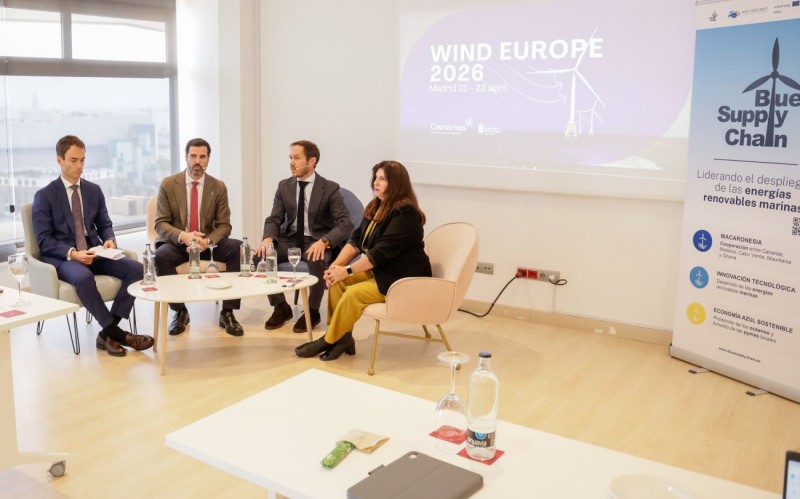
The PP has come out this Monday to attack the PSOE and defend the break from the national offshore wind power scheme. The Energy Counselor of the Government of the Canary Islands, Mariano Hernández Zapata (PP), and the administrator of Astican (Lavinia Group) and the Maritime Cluster of the Canary Islands, Germán Suárez; who in February defended the need for a solid nationalist parliamentary group in Madrid, presented in a press conference this Monday, April 13 in Las Palmas, the upcoming presence at the WindEurope fair that will take place in Madrid from April 21 to 23 at Ifema. At the event, the program that will be carried out at this international benchmark fair for the sector was announced. This will be the fourth edition in which the Canary Islands have participated, and every year the joint participation of the public and private sectors is reinforced to position the Canary Islands brand.
Zapata stated that ‘we want the Canary Islands not only to participate in the deployment of offshore wind energy in Spain but to lead its implementation with a model that is adapted to our reality and that guarantees energy security, sustainability, and economic opportunities for the islands.’ The president of the Maritime Cluster of the Canary Islands, Germán Suárez, asked: ‘And what do we expect from WindEurope?’. He answered himself: ‘We expect it to be the opportunity to bring home the much-anticipated announcement that the Canary Islands will have its own auction and will be a pioneer in the execution of the country’s first wind farm, which is what we have been working intensively towards, with exemplary consensus among all the stakeholders involved in the islands,’ he concluded.
The narrative of this pressure relies on the alleged loss of economic opportunities. The president of Gran Canaria, Antonio Morales, has warned that the ‘accumulated delay’ has driven away international investors, a narrative that seeks to expedite procedures through urgency rather than credibility. This is compounded by the promise of generating 8,000 annual jobs, a figure that various analysts view with skepticism given the embryonic phase of the industry and the lack of port infrastructure prepared for such operational volumes.
Despite the official discourse assuring that the wind farms will be six kilometers from the coast to avoid tourist impact, the Gran Canaria lobby avoids mentioning that this model of ‘fragmented territory’ entails technological and logistical costs that still need to be validated by the market. The insistence that this development would ‘lower’ the electricity bill clashes with the reality of a sector that, globally, continues to rely on significant subsidies and guaranteed auctions to be profitable.
Gran Canaria has thrown down the gauntlet to Madrid: either a specific auction is called under its unique conditions, or a political blockade is threatened in a matter where consensus should be technical and not merely local. The message to ‘stop talking about potentials’ to move towards ‘decisions’ is ultimately an attempt to impose the agenda of the promoters over the national regulatory caution.







