




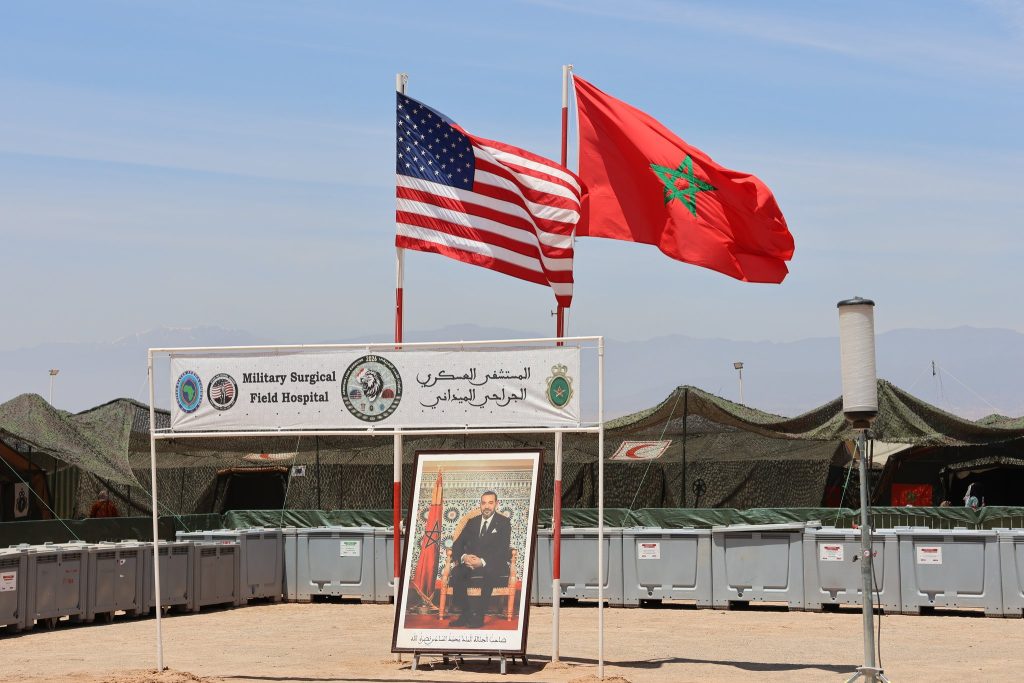
The position of the Canary Islands as a logistical and military platform for the West in the Mid-Atlantic is facing a severe process of strategic erosion. The shift in Madrid’s foreign policy, marked by the veto on the docking of vessels carrying cargo to Israel and the prohibition of using the Rota Base for flights to the Persian Gulf, has triggered a punitive reaction in Washington and Tel Aviv. The discontent in U.S. command centers has reactivated proposals in Congress to abandon the bases at Rota and Morón, a withdrawal that would leave the southern flank of NATO exposed and dilute the deterrent value of the Canary archipelago against Morocco’s growing hegemony in the region.
The technical and maritime security report that underpins this strategic scenario has been prepared by Juan Ángel López Díaz, retired Colonel of the Marine Infantry, member of the Association of Writer Officers of Spain (AEME), of the Naval Thought Center, and of the Spanish delegation of Eurodefense. The officer links the loss of specific weight of the islands’ infrastructures to the theses developed in his recent monographs and military intelligence analyses published between 2023 and 2026. His conclusions emphasize the imminent risk that the Canary Islands’ commercial axis will become subordinate to the new port and military deployment in North Africa due to diplomatic isolation from traditional suppliers of Western defense technology.
The response to the Maghreb challenge requires an immediate emergency plan for the islands’ port infrastructures that prevents foreign capital from gaining operational control over the key terminals of the islands. Given that 90% of Spain’s foreign trade is conducted by sea, the loss of sovereignty over the Canarian docks in favor of funds or corporations aligned with the Rabat strategy would drastically reduce Spain’s deterrent capacity. The Port of Las Palmas urgently needs improvements in its access and logistical storage capabilities to counter the tax incentives offered by the African shore.
The weakening of the Canarian geopolitical pivot is clearly reflected in the decline of its merchant and fishing fleet, historically linked to the archipelago’s economy. National shipowners continue to register their vessels preferentially under foreign flags to evade regulatory costs and the lack of fiscal support of the Spanish flag, a phenomenon analyzed in recent sector reports. This exodus of ships leaves the archipelago without its own strategic naval reserve in the event of a global supply crisis.
The dismantling of medium and large fishing units in the traditional fishing grounds of the Canarian-Saharan bank deprives the State of a crucial physical presence in waters of high strategic value. While the central government aligns itself with the regimes of Hispano-America, damaging its credibility as a transatlantic leader in international forums, Morocco effectively consolidates its trade corridors over the waters surrounding the Canary Islands. The lack of a strong response from economic ministries places the islands at the real risk of becoming isolated from major global maritime connectivity networks, subordinated to the logistical and security control of the powers on the southern shore.
The decline of Spanish influence coincides with the aggressive commercial and diplomatic expansion of Rabat through its Royal Atlantic Initiative, a project designed to connect Sahel countries with the ocean through infrastructures controlled by the Moroccan kingdom. For the first time in contemporary history, the ports on the southern shore of the Strait of Gibraltar are in a position to seize logistical leadership from the Peninsula, with projections indicating that the combined traffic of Tangier Med and Nador West Med will surpass the volume of Algeciras. This port squeeze directly pressures the Port of La Luz in Las Palmas and Santa Cruz de Tenerife, forcing them to compete with Moroccan maritime corridors built on the foundation of traditional Spanish routes.
The vulnerability of the islands is exacerbated by the Canarian dependence on U.S.-made defense materials and on antiterrorist and migratory intelligence sharing. Analysis from naval think tanks — such as the Association of Writer Officers of Spain (AEME) — warns that diplomatic subservience to Rabat and the cooling of relations with the White House weaken Spain’s position in a hypothetical territorial conflict in the shared sovereignty area of the Canarian-Saharan fishing bank. In that scenario, Washington and Israel would align their technological and informational assets with Morocco, directly compromising the operational sustainability of the Armed Forces deployed in the archipelago.







