




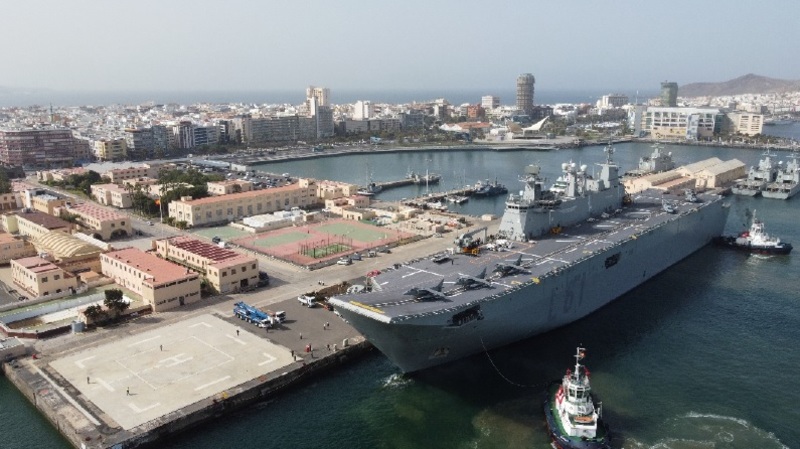
Since its first stone was laid in 1940, the Arsenal of Las Palmas has consolidated its position as the backbone of logistical support in the mid-Atlantic. What began as a strategic necessity in the post-war period is now a critical, unique, and indispensable infrastructure, without which the operations of naval units based in the Canary Islands or those transiting its waters would be incomprehensible. Its role extends beyond military walls; it is an engine of efficiency that has managed to combine military discipline with total integration into the social and port fabric of Las Palmas de Gran Canaria.
The Las Palmas Logistics Office has resolved the file for the rehabilitation of the Staff Support Office (OFAP) facilities at the Military Arsenal of the Gran Canaria capital. The contract has been formalized in favor of the temporary union of companies (UTE) formed by Servicios para la Infraestructura Castillo SL and Harado de Construcciones y Asistencias Técnicas SL, after presenting an offer of 441,985.01 euros.
The works, which have an execution period of eight months, will focus on the second phase of the modernization of building TA 26. The award has been decided based on purely automatic criteria, where the price accounted for 70% of the total score, complemented by the assessment of quality certifications (ISO 9001/14001), training in occupational risk prevention, and the technical qualification of the project manager.
With this intervention, the Ministry of Defense continues its plan to update infrastructure in the strategic enclave of the Arsenal of Las Palmas. The project, fully funded by the state budget without recourse to European Union funds, aims to optimize the efficiency of support services for military personnel stationed in the Canary Islands, balancing construction activities with the daily operations of the naval base.
The key to its longevity lies in its human capital. The personnel of the Arsenal, in a perfect symbiosis between military and civilian, sustain a structure that accommodates elite units and essential services such as the Canary Security Unit, the Diving Unit, the Logistics Office, and the Naval Museum. This amalgamation of capabilities transforms the site into a city within a city, where a positive and collaborative attitude has become the necessary methodology to tackle the security challenges presented by the current geostrategic environment.
The technical evolution of the Arsenal has been constant, marking milestones that have defined its modern physiognomy. Special emphasis is placed on the ambitious modernizations undertaken between 2009 and 2011. That reform was not merely aesthetic, but rather a vital adaptation to accommodate the Action Ships (BAM) of the Meteoro Class, a new generation of vessels that required infrastructure and technological capabilities commensurate with their cutting-edge design. This capacity for metamorphosis demonstrates that the Arsenal is not a static entity, but a dynamic institution that breathes in rhythm with the advances of the Naval Force.
Beyond the dock, the Arsenal is a committed neighbor. Its close relationship with the Royal Yacht Club of Gran Canaria, the Port Authority, and the City Council of the capital evidences a service vocation that transcends military spheres. As it celebrates its 75 years of history, the entity does not limit itself to looking in the rearview mirror; it projects itself towards the future with the determination of one who knows it is the reason for the existence of the Force. With its eyes set on the upcoming challenges, the Arsenal of Las Palmas reaffirms its commitment: to be the robust and effective logistical support that ensures Spain continues to navigate safely in the Atlantic.







