




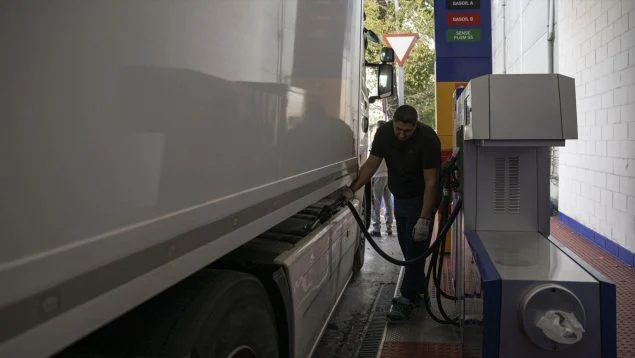
Gross tax revenue figures often serve as a political sedative to conceal underlying structural weaknesses. The Tax on Derived Petroleum Fuels (IC) in the Canary Islands, with a net accumulated collection of 337 million euros at the end of December 2025, is the latest example of how regulatory inertia cloaks a landscape of fiscal exhaustion. The accumulated nominal growth of 4.13% compared to 2024, along with advancements of 6.38% and 12.17% registered in the 2023 and 2022 fiscal years respectively, projects a false sense of robustness that collapses completely when public aid distortions are removed.
The introduction of the necessary adjustment to correct the impact of the Order of March 25, 2022—which raised the partial refund of the tax to farmers and transporters to 99.9% of the quota from March 2022 to December 2023—reveals the true contractive trend of the tax. When recalculating net homogeneous revenues excluding refunds, the supposed dynamism of the accumulated collection by December 2025 suffers a severe analytical cut, showing an anemic real growth of 0.35% compared to 2023 and a modest 7.08% compared to 2022. The toxicity of this data worsens when reviewing the homogeneous performance in 2024, a period during which actual net revenue not only stagnated but experienced a net decline of 3.63% compared to the previous year.
The monthly evolution of the tax confirms this bias towards deceleration in the final stretch of the fiscal year. Although the gross revenue for December 2025 reached 29.8 million euros, landing at the high end of the usual range of 25-30 million, the homogeneous terms again dampen the optimism of the regional government. The real growth for this month compared to December 2023 and 2022 contracted to 7% and 7.93% respectively, significantly lower percentages than the nominal rates of 13.29% and 10.90% initially advertised. Even the December 2024 revenue saw its real progress cut to a timid 2.34% compared to the gross 8.36%, evidencing that underlying consumption is losing traction.
Regulatory erosion and subsidy duplication
The deterioration of the archipelago’s revenue capacity is pressured by successive legal modifications aimed at reducing the tax burden on productive sectors. The creation of the new heading 2.2 effective from January 1, 2024, introduced by the eighth final provision of Law 7/2023 on the General Budgets of the Autonomous Community of the Canary Islands, established a reduced taxation of only 90 euros for industrial diesel, compared to the 222 euros of the general rate. This structural tax cut permanently weakens the potential revenue collection of the levy in the long term, limiting the resources available in a context of increasing budgetary demands.
The financial scenario complicates from February 1, 2025, with the entry into force of compatibility between the extraordinary discount on the retail sale price of refining and the partial refund of the IC. By allowing farmers and transporters to accumulate both benefits instead of having to choose one, the regulatory framework increases the indirect expenditure pressure on public finances. Although technically the retail discount does not deduct direct funds from tax revenue, the coexistence of both subsidies artificially subsidizes a highly vulnerable fossil consumption model.
The immunity of this tax to inflation introduces the most concerning element for the sustainability of public accounts. As a specific special tax that levies a fixed rate on the liters of fuel delivered wholesale, rather than an ad-valorem rate linked to market price, the general rise in prices does not increase revenue. Inflationary pressures raise the costs of public services that the Canarian administration must finance, but the IC revenues remain stagnant and are exclusively tied to the volume of liters sold. This tax rigidity reduces the real value of collected money, trapping the islands’ energy taxation in a pinch of lower real consumption and lower institutional purchasing power.







