




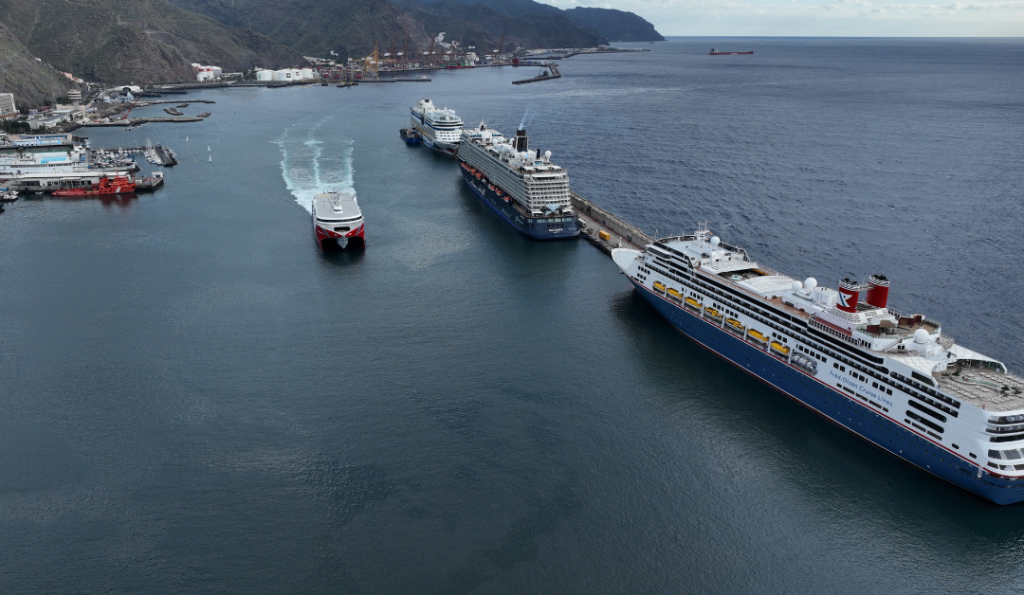
The General Directorate of Energy of the Government of the Canary Islands has formalized the administrative authorization for the emergency plant of Sampol I. and O. Canarias, S.L. in the Port of Santa Cruz, resolving a file (GE25/002) that is, in practice, the technical execution of Order TED/909/2025. This is what this Wednesday, February 11, 2026, is already published by the BOC.
The final location in Parcel B meets the requirements of the Port Authority of Santa Cruz de Tenerife, which has imposed ISO 14001 certification and continuous monitoring of noise and magnetic fields. It is a shock engineering piece: fossil fuel and post-treatment technology for gases to sustain a frequency grid that the Tenerife system can no longer guarantee by itself.
This plant, with a nominal power of 18 MW, acts as a rapid response unit to the coverage deficit identified by the System Operator. The infrastructure is subject to the extraordinary remuneration regime guaranteed by the Ministry for Ecological Transition for an initial period of three years, or until the power resulting from competitive bidding is commissioned.
It is a rescue
The business of the 18 MW in the Port of Santa Cruz is not an investment, it is a rescue. For Sampol to move a single finger, the Ministry must recognize a remuneration that covers an installation CAPEX that, in similar emergency plants, is around 800,000 euros per installed megawatt. We are talking about the commissioning of this equipment costing the electrical system an initial investment of approximately 14,400,000 euros, just for the deployment of the ten groups, the 66 kV substation, and the installation of 630 mm² cables under the asphalt of the Fishing Dock.
Sampol has negotiated that the bulk of that 14.4 million euro investment be recouped during the emergency lifecycle (3 years). This means that the electrical system is injecting almost 5,000,000 euros per year just to pay for the equipment, regardless of whether they function or not. It is a round business where the market risk is zero: the only risks are administrative (that a judge disapproves the authorization due to noise) or technical (that the SCRs fail and Public Health seals the plant). Aside from that, Sampol has rented its generators to the State at a price that any leasing company would envy.
East Dike
The electromechanical configuration is based on a distributed generation scheme of ten three-phase generator sets (2,295 kVA/unit) with low voltage output (400/230 V). The evacuation design includes a two-stage transformation: a first phase from 0.4 to 20 kV through ten dedicated transformation centers and a final elevation stage to 66 kV in a 25 MVA (ONAN) power transformer. The interconnection with the transmission grid will be made at the East Dike substation through a simple circuit with 630 mm² conductors, projected under the roadway of the Fishing Dock.
We can
The resolution had to navigate significant technical opposition during the allegation process, such as that from Nohemí Santana (Unidas Podemos), focused on the absence of an Ordinary Environmental Impact Assessment. However, the Administration has validated the simplified evaluation procedure citing the provisional nature of the groups and the urgency arising from Decree 186/2025. To neutralize the impact of NOx emissions, the plant will be required to integrate selective catalytic reduction (SCR) systems, conditioned to a strict operation regime limited to between 500 and 1,000 hours annually. Any deviation from this load dispatch will necessitate a new review of the public health impact.
In terms of planning, the plant has been imposed through the declaration of general interest, allowing for the automatic alteration of the General Planning of Santa Cruz de Tenerife.
News written by Raquel Molina. Edited and verified by Pedro Marrero. Cross-checked information without institutional filters. This analysis has not been funded by official advertising or conditioned by lobby interests.







