




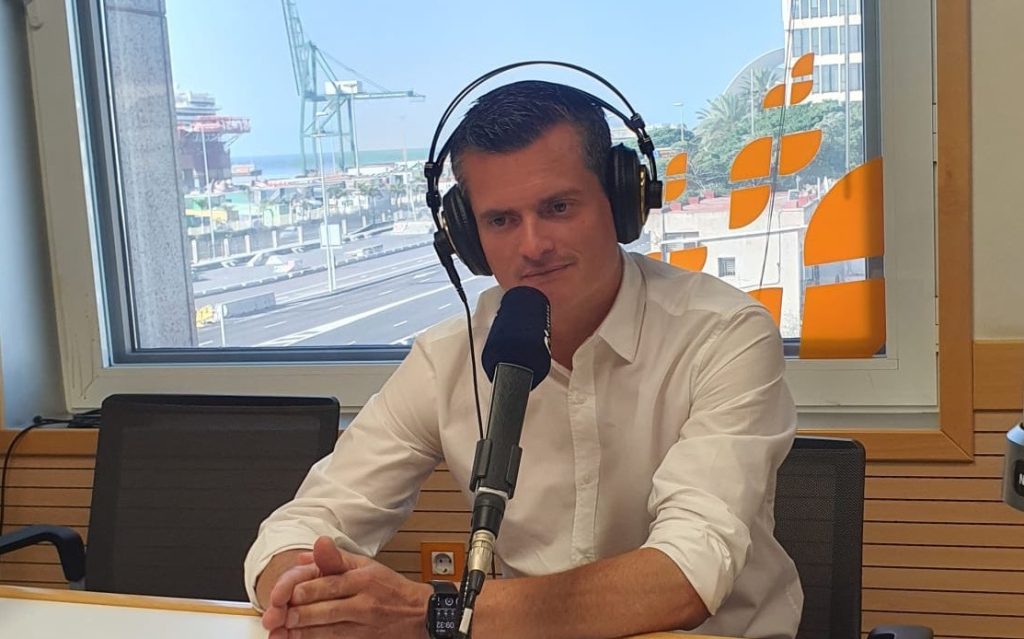
The national deputy of the PP of the Canary Islands in Madrid and captain of the merchant navy, Juan Antonio Rojas, denounced this Tuesday the sophisticated plot of money laundering of Russian hydrocarbons that uses the ports of the Canary Islands by employing manipulation of location systems to hide their routes and evade sanctions imposed by the European Union and the G7 following the invasion of Ukraine. The complaint follows the news from this newspaper warning that a barge is arriving at the port of Las Palmas on January 4, which triangulates through Gibraltar and is supposedly bringing Russian hydrocarbons. The Paxoi is the one arriving this Wednesday in Las Palmas. He stated that ‘effective’ coordination between the Navy, Maritime Rescue, the Civil Guard, the maritime captains, and the Canary authorities is ‘essential’ to act with ‘speed and efficiency in the EEZ’.
In the Port of La Luz, 14 calls of vessels linked to this network have been recorded (such as the Paxoi, Kefalonia, and Naxos II), which would have unloaded nearly 78,700 tons of diesel and fuel under flags of convenience. Both the Popular Party and Coalición Canaria (CC) have moved in Congress. The nationalist deputy Cristina Valido will request specific information about the transit of these ships through the islands, warning of the environmental risk posed by this ‘dark’ fleet in an Especially Sensitive Marine Area. The Government of Spain states that it maintains constant satellite surveillance, recalling the recent case of the Russian tanker Agate, which lingered days south of Tenerife avoiding international sanctions.
The core of the fraud lies in the alteration of the Automatic Identification System (AIS). This technology, mandatory for vessels over 300 tons, allows for knowing the position, course, and speed of the tankers. According to Rojas, the involved vessels turn off or falsify this data to camouflage cargo transfers at sea and hide the origin of the fuel. ‘Our islands cannot continue to be a blind spot in the Atlantic,’ warns Rojas, who demands a ‘deterrent and constant’ presence of the Spanish Navy.
Rojas points out that the current situation cannot be addressed with ‘passive or sporadic’ surveillance, so he has demanded a ‘greater involvement’ from the State in a strategic area such as the Exclusive Economic Zone (EEZ) of the Canary Islands, as reported by the PP of the islands in a press release following the news reported by Canarymaritime. He stated that the Canary Islands ‘cannot’ continue to be a ‘blind spot’ in the Atlantic, pointing out that the EEZ is ‘the direct responsibility’ of the State and requires an ‘effective, deterrent, and constant’ presence of the Spanish Navy.
Furthermore, Rojas has considered that this naval presence ‘must be accompanied by a clear reinforcement’ of aerial and maritime means, stating that ‘it is essential to substantially increase’ both manned and unmanned aerial reconnaissance flights, as well as maritime patrols to detect vessels at anchor, irregular transfers, or deliberate shutdowns of location systems. On the other hand, Rojas has also referred to the proliferation of vessels with hidden shipowners, flags of convenience, and manipulated Automatic Identification Systems (AIS), as it poses a ‘real risk’ of accidents and spills with ‘irreversible consequences’ for a territory declared as an Especially Sensitive Marine Area.
‘We are talking about a direct threat to the environment, the economy, and the security of the Canary Islands‘, he said, adding that this is compounded by recent information on practices of ‘laundering’ Russian hydrocarbons through complex routes and operations at sea. He also stated that if there is no ‘effective and ongoing’ control, the waters near the Canary Islands and the Spanish coast ‘become an especially vulnerable space’. Rojas also insisted on the ‘need to improve’ coordination among the various administrations and agencies with competencies in the maritime field because, he emphasized, ‘it is not enough to have means if there is no actual coordination and clear protocols’ of action.
News written by Pedro Marrero. Edited and verified by Gara Vega. Information cross-checked without institutional filters. This analysis has not been financed by official advertising nor conditioned by lobby interests.







