




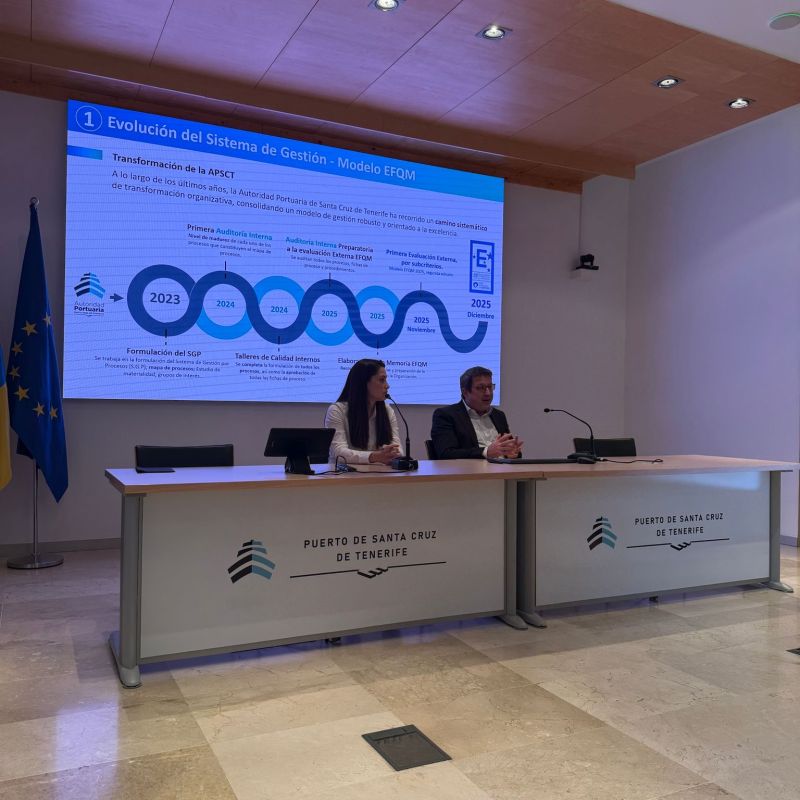
In a move aimed at consolidating its corporate governance against the growing competition from the logistics ‘hubs’ of the Mid Atlantic, the Port Authority of Santa Cruz de Tenerife (APSCT) has formalized the deployment of its new EFQM Action Plan. The initiative arises after the 2025 external audit, where the Tenerife port achieved the EFQM 400 Seal, a quality metric that places the organization in the top quartile of efficiency among Spanish public entities.
The plan, supervised by the APSCT’s Quality Systems technical management, is not limited to administrative validation but is structured as a response to the ‘opportunities for improvement’ identified in the last review. According to internal sources from the port authority, the roadmap seeks to transform the traditional management model into an ecosystem of ‘tangible results’ that delivers direct value to both large cargo operators and cruise lines, at a time when efficiency in port services is a decisive factor for the diversion of global routes.
Maritime logistics analysts point out that the adoption of European excellence standards (EFQM) is a clear signal for investment markets and international insurers. In an environment where transparency and continuous improvement are indispensable requirements for attracting European Union funds, Tenerife appears to be aligning its command structure —led by its Presidency and Management— with the demands of an increasingly technified and regulated maritime trade.
The immediate challenge for the APSCT will be the ‘operational deployment’: turning quality indicators into a real reduction in turnaround times and optimizing the supply chain. With this step, Santa Cruz de Tenerife aims not only to retain its market share against its perennial regional rival, Las Palmas, but also to project an image of institutional stability and technical solvency in an economic landscape marked by energy volatility.







