




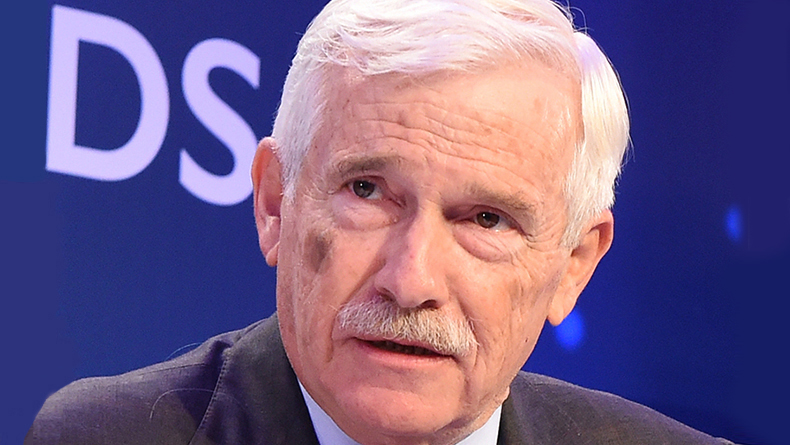
The military escalation in the Middle East has placed global maritime transport in a scenario of unprecedented vulnerability, where the security of essential trade routes hangs by a thread. Panos Laskaridis, CEO of Laskaridis Shipping and a prominent figure in the shipping industry as owner of Astican in the Canary Islands, stated in an interview with Business Daily last weekend that the situation in the Strait of Hormuz is deteriorating alarmingly. Meanwhile, last weekend in Canarias 7, the sole director of Astican, Germán Carlos Suárez, echoed Pedro Sánchez’s discourse lamenting the tension in Spanish political life. A few weeks ago on Cadena Ser, he urged Canary nationalists to unite to have their own parliamentary group in Madrid.
According to the shipowner and retired rear admiral of the Hellenic Navy, with historical interests in Las Palmas since the state privatized Astican, the technical and military complexity of the conflict prevents reliable projections, stating that ‘no one can accurately predict the repercussions’ of this new crisis that tests the limits of the global economy.
The de facto blockade in the Strait of Hormuz has segmented the risk for the international fleet, critically affecting tankers trapped in the conflict zone. Laskaridis points out that the safety of crews is now the absolute priority, warning that ‘there is a risk for crews, especially in the case of certain ownership and flag vessels’. This logistical paralysis, coupled with the relocation of routes to the Atlantic, is reconfiguring spheres of strategic influence, as the businessman notes that the current situation ‘will lead to a general crisis throughout the region and broader adjustments in the overall political and military-strategic development.’
Despite the pessimism surrounding the development of the confrontation, Laskaridis maintains that the international economy exhibits a resilience greater than that demonstrated during the 1973 oil crisis. In his analysis, the shipowner considers that the world is ‘much better prepared for many reasons, such as the development of renewable energy sources or the enormous exports from the United States.’ Nevertheless, he acknowledges that the stability of markets in the long term is an unknown that ‘depends on the damage and destruction that may have occurred in the installations and refineries of the Gulf states,’ infrastructures that are vital for price balance in the Canary archipelago.
For the shipping sector, the immediate future depends on the global economy’s capacity to absorb this unprecedented geopolitical shock of the decade. Laskaridis insists that, although the outlook is grim, ‘it is impossible to predict anything at this moment’ as the situation fluctuates with extreme rapidity. The industry is forced to operate in an uncertain environment where the only certainty is that the map of maritime transport is being redrawn. As Laskaridis himself concludes about the crude oil market, ‘it is still too early to have a complete idea of how the market will evolve in the near future.’







