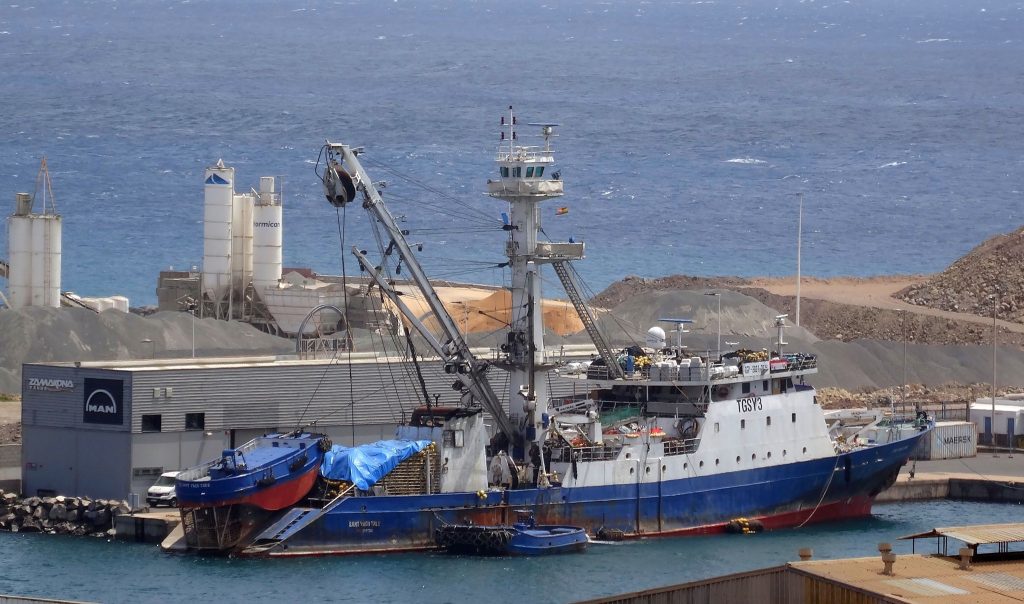
The Port Authority of Las Palmas has closed the year 2025 reaffirming its strategic leadership as the main center for maintenance and ship repair in the region. The metrics of logistical intelligence underscore the geopolitical importance of the port of Las Palmas: 45% of deep-draft repairs come from critical infrastructures in Nigeria, while the flags of Panama and Liberia account for 62% of the gross tonnage under repair.
In a market dominated by three operators, one Greek and two Spanish, in alphabetical order Lavinia, Hidramar and Zamakona, the year where general cargo traffic showed adjustments, the port consolidated itself as a critical technical stop, recording a total of 1,371 technical operations, broken down into 454 specific repair calls and 917 technical service and provisioning calls. This activity not only generates revenue from port fees but guarantees an average stay of 8.4 days per vessel, a retention ratio that multiplies profitability per scale compared to conventional loading and unloading operations.
The responsiveness has been such that the port of Arinaga absorbed 105% of the provisioning surplus, acting as a relief zone during the periods of congestion in December and March, key months for the renewal of navigability certificates. With an infrastructure capable of accommodating everything from giant offshore platforms to deep-sea fishing fleets, the port has managed a constant flow of assets that reinforces its role as a technical hub among three continents. This year’s exhaustive census reveals a specialization by segments that optimizes the operational capacity of its auxiliary industry.
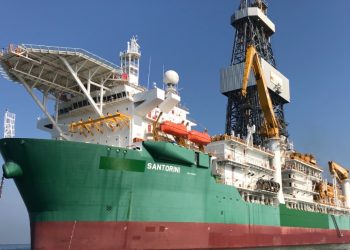
At the level of maximum technical complexity, high-tonnage units (over 50,000 GT) constitute the core of the offshore infrastructure. The Atwood Admiral (70,438 GT) and Atwood Archer (70,400 GT) vessels, under Marshall Islands flag, lead this category with operations linked to the energy cluster of Nigeria (Onne/Port Harcourt) and return to the South Atlantic. They are joined by drilling vessels Valaris DS-12 (57,000 GT) and Valaris DS-10 (57,000 GT), along with Stena Forth (58,294 GT) coming from Ghana.
The bulk and general cargo transport segment (15,000 to 50,000 GT) shows a strong connection with the North Atlantic and Ibero-America. Notable units include the Roland Oldendorff (33,057 GT, Liberia flag) operating between Safi and Santos, the Marie Curie of Balearia (28,658 GT, Cyprus flag) coming from Valencia towards Barcelona, and the Nordic Star (22,462 GT) along with the Side Rodi (19,000 GT), both coming from Northern Europe for preventive maintenance. Additionally, the SFL Thelon (42,000 GT) made critical engine stops, while the Zhen Hua 25 (38,000 GT) and Celsius Cincinnati (17,500 GT) reinforced technical activity in transit.
Medium logistics and specialized cabotage (2,000 to 15,000 GT) represent the group with the highest turnover, essential for maintaining the port’s containerization rate at 80.3%. In this group operate vessels such as Brenas Cargo (10,585 GT), Diana B. (8,280 GT) coming from Algeciras, and recurrent maintenance units like Candelaria B (7,519 GT). Also noteworthy is the annual propulsion review of Lobo Marinho (5,191 GT) and the presence of specialized assets in chemicals and gases from the Netherlands, such as Maximus (3,500 GT) and Coral Adriana (4,000 GT), in addition to vessels like Vantage 5, SVS Monreale and Karyatit.
The fleet of services and deep-sea fishing (under 2,000 GT) accounts for 38% of the total workload of the business. The Spanish sovereignty units Esperanza del Mar and Juan de la Cosa maintain their permanent base, accompanied by tugboats like Maresa Dos, Ardentia Anguiera, and VB Adriático. In the extractive sector, the list includes Mansour Dakhla, Agadir I, Sierra Leyre, Pesca Verde, Isla de Lanzarote, and Playa de Arruza coming from Mauritania and the Sahara, alongside tuna vessels like Montelaura and research units like TETHYS and Albatros II.
This news was written by Pedro Marrero. Edited and verified by Gara Vega. Cross-checked information without institutional filters. This analysis has not been funded by official advertising nor conditioned by lobby interests.