




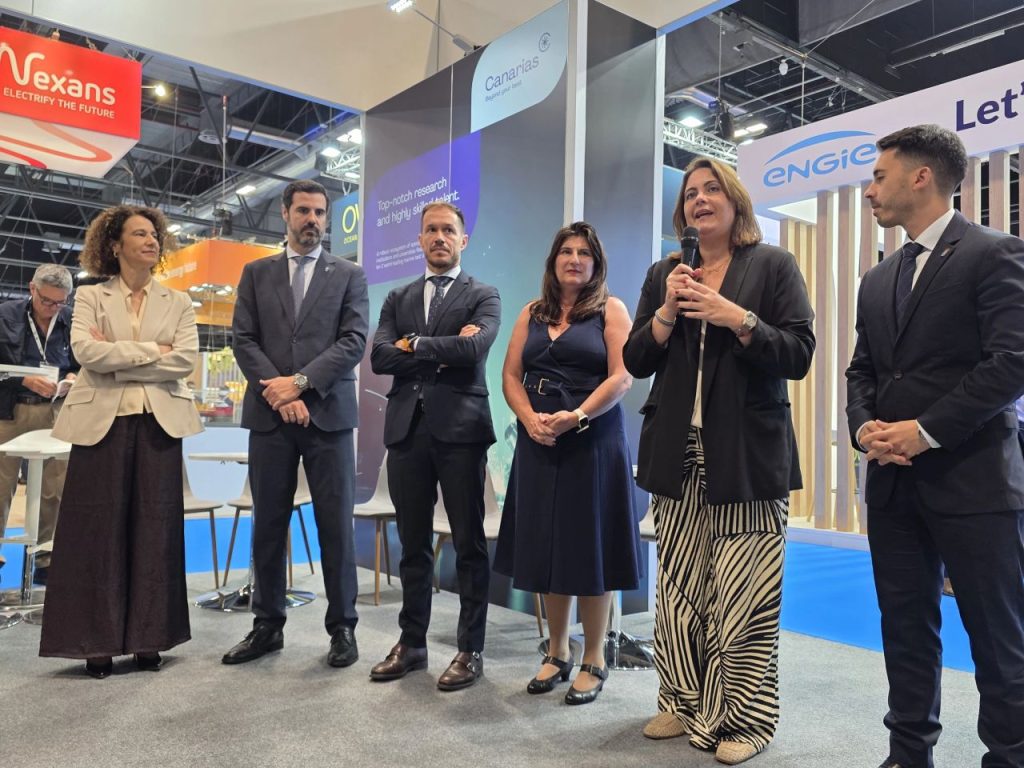
Beatriz Calzada has decided that the office at the Port of Las Palmas was too small for her ambitions, and she has set out on a tour that puts to shame those of her eight predecessors. In just seven days, the president of the Port Authority of Las Palmas has stepped foot in the United States, Brazil, and Guatemala, demonstrating that in order to be a tricontinental hub, one must first wear out a lot of shoe leather and accumulate a number of frequent flyer points that, if measured officially, would belong to the state.
The first stop was Miami, the city where the cruise sector gathers to decide which port will be the next to host thousands of tourists in shorts. Calzada returned with the trophy: Las Palmas will be the venue for the Seatrade Cruise Med 2026. After closing 2025 with two million cruise passengers—an appealing number for statistics but less so for those trying to navigate Triana street—the port of Gran Canaria confirms its status as the favored destination for ships that are larger than the very towns they visit.
Without time to unpack, Calzada landed in São Paulo. At the Intermodal South America fair, the Canary delegation devoted itself to explaining to Brazilians that if they want to send something to Africa, the best option is to take a detour through Gran Canaria. The goal is to transform the Port of La Luz into the ‘bridge’ necessary to ensure that South-South trade does not get lost along the way. ‘Our objective is to connect Brazil with Africa more directly,’ stated the president, while Brazilian operators tried to pinpoint on the map that strategic point that promises to optimize their supply chains between caipirinhas.
The final leg of the tour took place in Antigua, Guatemala, under the auspices of the UN. There, in an environment more conducive to meditation than to terminal management, Calzada gave a master class on climate change. Before 150 Latin American representatives, she asserted that adapting to the environmental apocalypse ‘is not an option, but a condition.’ A phrase to remember that ports are no longer merely sites where containers are stacked but rather critical systems that must learn to float—literally—if they wish to remain competitive in the new digital order.
This diplomatic marathon makes one thing clear: the Port of Las Palmas no longer aspires to be merely a gas station in the middle of the ocean. It now wants to be the workshop of the world, the event hall for shipping companies, and the sustainability guru—all at once and across three different time zones. Calzada’s port diplomacy has put the islands on the map, even if it may mean the president needs a month off to recover from institutional jet lag.







