




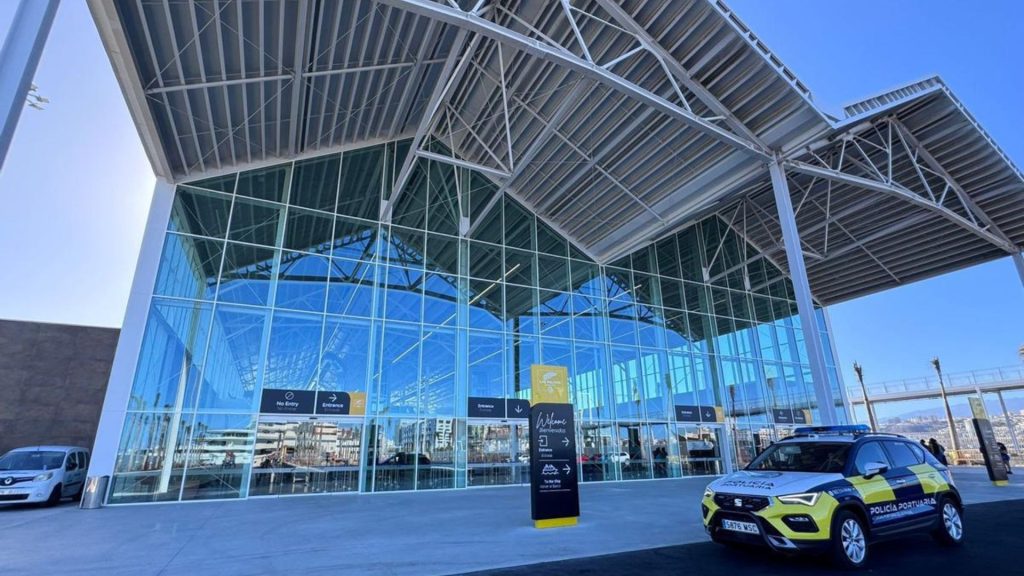
The center of gravity of cruise tourism in Europe has officially shifted south. This Thursday, March 19, the Port Authority of Las Palmas and Global Ports Holding (GPH) will cut the ribbon on the new maritime station at the Santa Catalina Dock, establishing it as the largest cruise terminal on the continent.
The infrastructure, which has required an investment of approximately 34 million euros financed with corporate debt, encompasses 14,000 square meters. The key to this terminal lies in its processing capacity. Equipped with three state-of-the-art boarding bridges, the station can handle the simultaneous operations of up to four large-draft ships. This versatility is critical to consolidating Las Palmas not only as a transit port but also as a base port, the most profitable segment of the industry due to induced spending in hotels and air transportation.
The design, which was tested last October with the call of the Celebrity Apex, aims to optimize the flow of thousands of passengers in record times, a metric that Mehmet Kutman, president of Global Ports Holding, considers vital to maintain competitiveness against hubs in the Caribbean and Eastern Mediterranean. Along with Kutman and the port president, Beatriz Calzada, key figures such as the president of Port Authorities, Gustavo Santana, will attend.
Despite the official inauguration, the project still has certain open fronts in its periphery. The outer esplanade, a 17,800-square-meter space intended to integrate the dock with the urban landscape through flowerbeds and pedestrian areas, is still in the bidding phase for its final touches (lighting and paving). With the capacity to simultaneously accommodate giants like the Queen Victoria or the Mein Schiff 7, Las Palmas is not just inaugurating a building; it is inaugurating a new era where the performance per square meter of the dock is now measured by the satisfaction of luxury passengers and the efficiency of tourist handling.







