




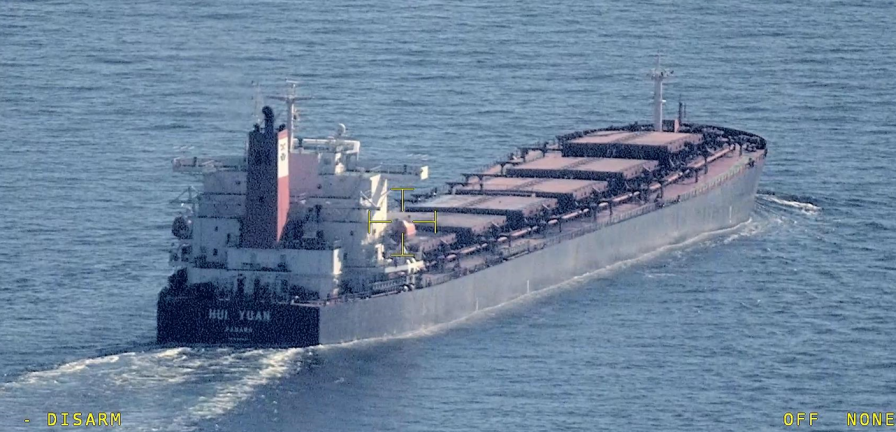
The cargo ship of Russian influence, Hui Yuan, has entered the Port of Las Palmas under intense international regulatory surveillance. The vessel, which sails under the flag of Panama but originates from Russian ports, arrives at the archipelago after a critical incident in the Baltic Sea that triggered alarms from the Swedish Coast Guard. The ship was boarded off the coast of Ystad after aerial images detected the illegal dumping of coal waste into the sea, an environmental violation that Scandinavian authorities have used as leverage to intervene in an asset suspected of belonging to the logistical networks of Moscow.
Elisabeth Braw, a senior researcher at the Scowcroft Center for Strategy and Security, within the Transatlantic Security Initiative, citing the case of the ship that has arrived in Las Palmas, pointed out this Thursday that ‘the new behavior of the shadow fleet and Russia’s involvement in it could indeed be the clearest example of the collapse of the international rules-based order, even amid the proliferation of rule violations in various parts of the world.’
The Swedish operation transcends mere ecological infringement. Sweden has directly linked the Hui Yuan with the so-called ‘shadow fleet,’ the complex system of opaquely-owned vessels used by the Kremlin to evade Western sanctions arising from the invasion of Ukraine. Although the ship was carrying coal instead of crude oil on this voyage, Baltic powers have shifted towards a ‘zero tolerance’ policy, using any technical or environmental irregularity to inspect and obstruct the operations of vessels linked to Russian interests.
Stopover in the Atlantic and destination India
After undergoing questioning by the Swedish prosecutor’s office and being released from boarding, the Hui Yuan has maintained its course towards the Canary Islands, a vital logistical node for re-supply before tackling long-distance routes. However, its stay in La Luz will be brief. The vessel has formally expressed its intention to head to India, a move that aligns with the pattern of redirecting Russian raw material exports towards Asian markets, which have become Moscow’s main financial lifeline amid the closure of European ports.
The cargo ship’s passage through Las Palmas tests the control mechanisms of the port state at a moment of maximum geopolitical sensitivity. The presence of vessels flagged by European naval intelligence in Spanish waters necessitates a delicate balance between fulfilling port commercial services and overseeing international sanctions. For the freight market, the case of the Hui Yuan serves as a reminder that environmental risks are now the new frontier of the sanctions war, where a coal stain in the Baltic can end up in a security report in the Atlantic.







