




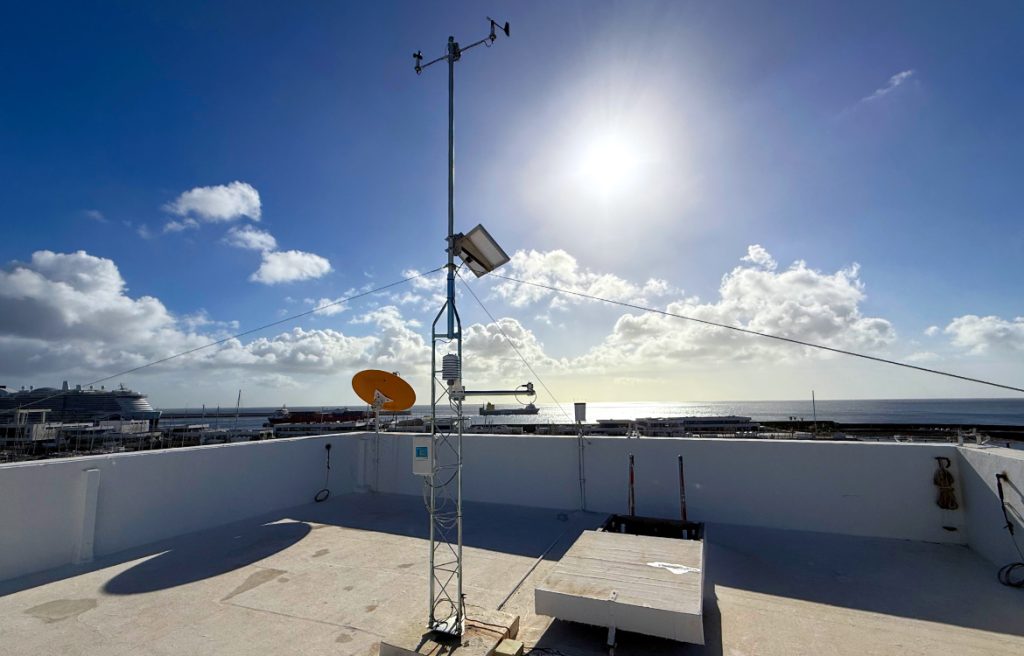
Maritime training in the archipelago has made a qualitative leap this March 2026 with the installation of a high-performance 3R AWS100 weather station at the Maritime and Fishing Vocational Training Institute of the Canary Islands. This state-of-the-art equipment, deployed by the specialized company Darrera, allows the Arrecife center to monitor the environmental conditions of the eastern coast of Lanzarote in real time. The initiative not only benefits students but also extends its utility to the entire nautical community by sharing data openly through the international Weathercloud platform, facilitating decision-making in an increasingly complex port environment.
The choice of the 3R AWS100 station responds to the need for tools with surgical precision in a professional training context where theory must be validated with daily practice. The system, strategically located on the rooftop of the building on a tilting mast, features an arsenal of sensors including a cup anemometer, wind vane, thermohygrometer with radiation protection, automatic tipping rain gauge, barometer, and pyranometer. This configuration ensures the capture of critical data even in the salinity and corrosion conditions typical of the marine environment, while operating entirely autonomously through solar energy.
From an operational perspective, the technological integration allows institute personnel and prospective industry professionals to access detailed reports in PDF and CSV formats, as well as to configure alerts for adverse weather phenomena. The ability to transmit data via 4G ensures that information flows uninterrupted to the monitors in the center’s lobby and its website. This digitization of climatic variables is fundamental for maneuver planning and safety at sea, consolidating the Lanzarote center as a benchmark of modernity in fishing and navigation instruction.
At a time when Atlantic logistics faces challenges due to route deviations and energy market volatility, the training of Canary Island sailors with precision tools becomes a strategic asset. The ability to analyze historical data and local trends allows students to familiarize themselves with the wind and wave patterns that define the operability of Canary Islands ports. With this addition, the Maritime and Fishing Vocational Training Institute of the Canary Islands reinforces its commitment to practical training that places its graduates at the forefront of safety and efficiency in the European naval sector.







