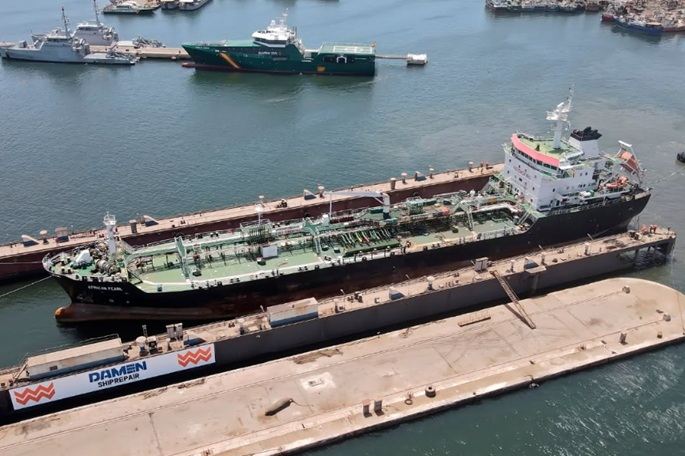
The naval repair landscape on the western coast of Africa and the Canary Islands is accelerating its structural reconfiguration. In a coordinated strategic move to capture the flows of the offshore and shipping energy industry, the Dutch giant Damen Shipyards Group has officially reactivated its commercial operations in Senegal after successfully completing maintenance on the vessel African Pearl, while the Hidramar group in Santa Cruz de Tenerife continues to endure bureaucratic delays.
The launch of the new large-tonnage floating dock in Tenerife, a project designed to compete in the lucrative Panamax ship market that has so far evaded the island’s shipyards, is generating cobwebs. The reason? The same factors highlighted by the World Bank regarding the port of Santa Cruz de Tenerife, as reported by Canarymaritime: bureaucratic third-worldism that even Senegal surpasses in efficiency. The Canarian port ranks 238th in the world for bureaucratic obstacles.
Didn’t they know it was coming?
In Tenerife, there was disbelief regarding the investment by Hidramar, because it defies logic that, knowing this structure would arrive two years prior, they did not activate reception mechanisms for the work. The reactivation of Dakar by Damen does not aim to compete head-on with the gigantism of the new Canary installations, but rather to absorb the demand from the coastal support fleets of West Africa and the renewal of units for regional navies. The delays from Hidramar’s Canary platform are already causing issues for fleets that planned to anchor in the Canary Islands for new naval repair services.
The resumption of operations in Dakar represents the culmination of a far-reaching political-economic alliance. Under a joint venture formula with the Senegalese Government, represented by the Société des Infrastructures de Réparation Navale (SIRN), Damen assumes the operational management of a facility staffed by over 300 personnel. The comprehensive refurbishment of the African Pearl, which has included complex structural interventions in steel, high-tech hull treatments, and mechanical inspections under international classification society standards, serves as the calling card for this public-private consortium, aimed at aligning demanding safety standards in the offshore sector with the global model of the Dutch multinational.
Objective Data: The Dates
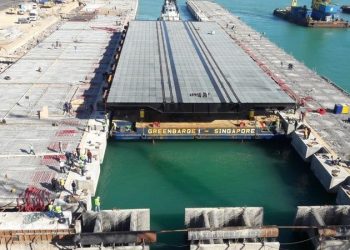
Less than 1,500 kilometers north of the Senegalese capital, investment dynamics in the Canary Islands are responding with an unprecedented deployment of private capital infrastructure in the region’s naval history. Hidramar completed the positioning and mooring of its new floating structure, named Hidramar Ultra 22000, at the docks of Tenerife at the end of April. In Senegal, Damen took over the dock that was paralyzed on May 11, and by June 12, they were already repairing a vessel, with a Guardia Civil patrol boat as a witness.
The incorporation of the dock in Tenerife, representing a total investment of nearly 50 million euros between the acquisition of the structure and associated ground infrastructure developments, would break a technical glass ceiling that penalized the competitiveness of the archipelago. To date, the merchant fleet and Panamax-type logistic support vessels—characterized by maximum allowable beams of 32.3 meters—did not have facilities in the island environment capable of supporting dry dockings if they exceeded 10,000 tons of deadweight or lengths greater than 175 meters. With the new platform’s entry into service, which has a lifting capacity of 22,000 tons, the Canarian naval sector is set to immediately expand its target market towards large container ships and energy exploitation platforms at anchor, preventing shipowners from diverting their fleets to traditional shipyards in the Iberian Peninsula or Northern Europe.
The scheme designed by Damen in Senegal also envisions a substantial investment in human capital to ensure the long-term sustainability of the business. According to the company’s regional director for Africa, Frederick Vandepitte, the corporation’s plans include the immediate opening of a local technical training center aimed at elevating the skills of the Senegalese workforce and standardizing management processes in information technology and human resources at the shipyard with the group’s global network. By stabilizing Dakar’s technical capacity and expanding the physical lifting limits in Tenerife, the West African maritime corridor articulates an integrated industrial services offering capable of retaining the added value of large global fleets without the need to leave the waters of the Central Atlantic.