




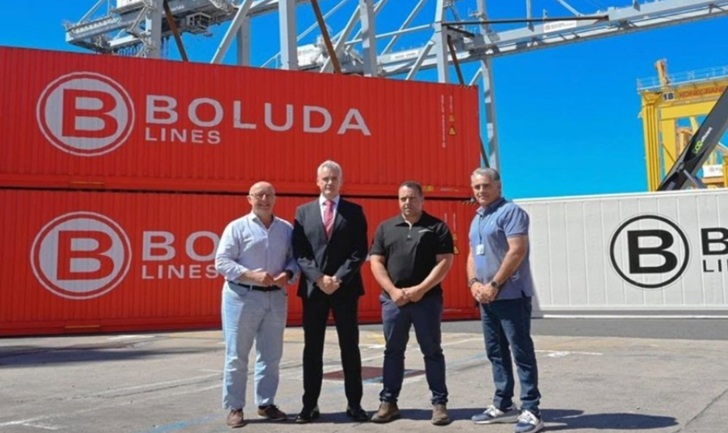
Hierarchy and message to the maritime operator’s staff: The command is based in Valencia, not from Las Palmas. The official presentation of the new equipment of Boluda Maritime Terminals, a Moroccan-capital company in the consolidation phase, at the Bufadero dock highlighted a significant fracture in the institutional representation channels of the company. The general director of Boluda Shipping, Javier Climent, led the reception event for the new state-of-the-art cranes alongside the president of the Port Authority of Santa Cruz de Tenerife, Pedro Suárez, and the leader of the right-wing stevedores’ union, Antolín Goya. The event, conceived as the ideal framework for the operational rollout of the terminal, confirmed the absence of the new Boluda representative in the islands, Bernardino Santana, who was omitted from the invitation and the official photograph of the meeting.
The deployment of assets comprises two Super Post-Panamax Ship to Shore (STS) cranes and four hybrid RTG units supplied by Konecranes. The maritime division of the multinational seeks with this capital injection to raise the competitiveness of the facility in light of the global reconfiguration of maritime supply lines, heavily influenced by mandatory detours around the Cape of Good Hope. The technical goal is to enable the Tenerife terminal to handle high-volume calls operated by Ultra Large Container Vessels (ULCV).
Specifications and technical balance
The new STS lifting equipment features a reach capacity of up to 22 rows of containers and a lifting height set at 60 meters. The operational system includes Twin mode for the simultaneous management of up to 71 tons and a maximum tolerance of 88 tons under the hook. The Port Authority of Tenerife has framed this private capital movement as a validation of the efficiency of public infrastructure, aimed at capturing international transshipment traffic through reduced turnaround times and improved energy recovery systems in the network.







